


I'm Saqib Iqbal, a licensed clinical social worker and the founder of Eye Cue Mental Health in Cerritos. One of the most common things I hear, especially from clients in our LA and Orange County communities, is some version of "I'm scared something is really wrong with my body, but every test comes back fine." If that sounds familiar, this guide walks through what health anxiety symptoms tend to look like and when it helps to get evaluated. If the worry is wearing you down, anxiety therapy at Eye Cue Mental Health can help.
What are health anxiety symptoms?
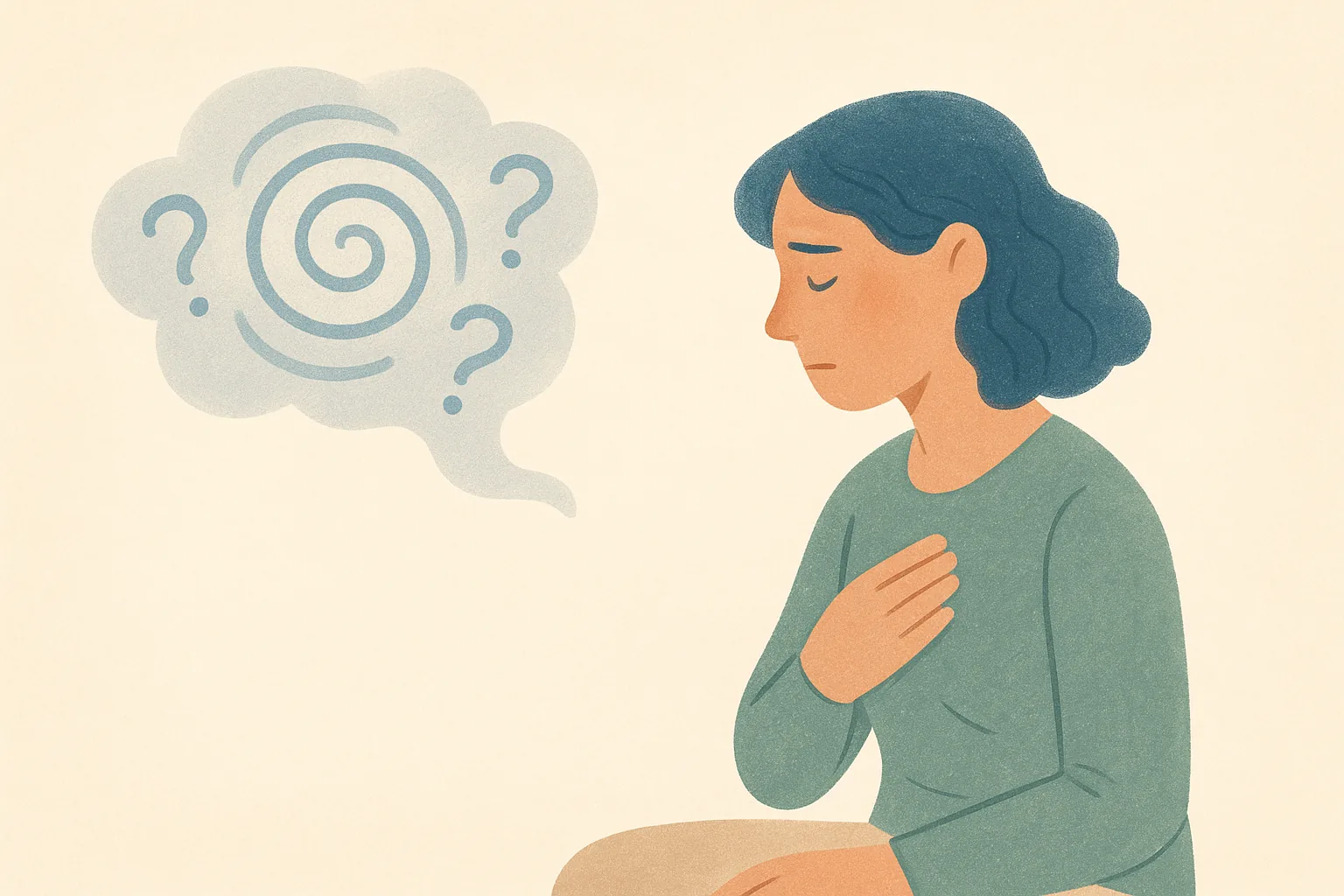
Health anxiety symptoms are the signs of persistent, distressing worry that you have or will develop a serious illness, often out of proportion to any real medical evidence. The worry usually shows up in three places at once: your thoughts, your behavior, and your body.
That last part surprises people. Anxiety itself creates physical sensations, so the fear of being sick can produce very real symptoms that then feel like proof you're sick.
Before I go further, an honest and important note. Physical symptoms deserve a medical checkup. Health anxiety is something a clinician considers after a physician has looked at what's going on, not instead of that visit. This article is educational, not a diagnosis.
The mental signs: what the worry sounds like
The thinking pattern behind health anxiety is a loop of "what if." A normal sensation, a headache, a skipped heartbeat, a new mole, gets read as a possible catastrophe rather than an ordinary body doing ordinary things.
Common mental signs I hear described include:
- Persistent fear that a minor symptom points to something serious like cancer or a heart condition
- Trouble believing reassurance from doctors, or feeling calmed for only a day or two
- Scanning your body for anything new or "off," and fixating once you notice something
- A sense that if you stop worrying, you'll miss the one warning sign that mattered
Here's the part that keeps people stuck. The doubt never fully resolves. You can get a clean scan on Monday and feel the fear creep back by Wednesday, because certainty about the future body isn't something any test can hand you.
The physical signs: how anxiety shows up in the body
This is the confusing overlap. Anxiety switches on the body's stress response, and that response is physical. According to the National Institute of Mental Health, anxiety disorders can involve a racing heart, sweating, trembling, and a sense of impending doom, alongside the worry itself.
So the sensations people watch for as evidence of disease are frequently the anxiety itself:
- A pounding or racing heart, or the feeling of skipped beats
- Chest tightness, shortness of breath, or a lump-in-the-throat feeling
- Dizziness, lightheadedness, or feeling detached
- Stomach trouble, nausea, muscle tension, and fatigue
The trap works like this. You feel a real sensation, you interpret it as danger, the fear ramps up the stress response, and the sensation intensifies. Now it feels like harder proof. That doesn't mean the feeling is "in your head" in a dismissive sense. It's a genuine physical experience with an anxiety driver, which is exactly why a medical checkup and mental health support can both belong in the same plan.
The behavior signs: checking, googling, and reassurance
Health anxiety usually comes with behaviors meant to relieve the fear. They work for a moment, which is the problem, because short-term relief teaches your brain to repeat them.
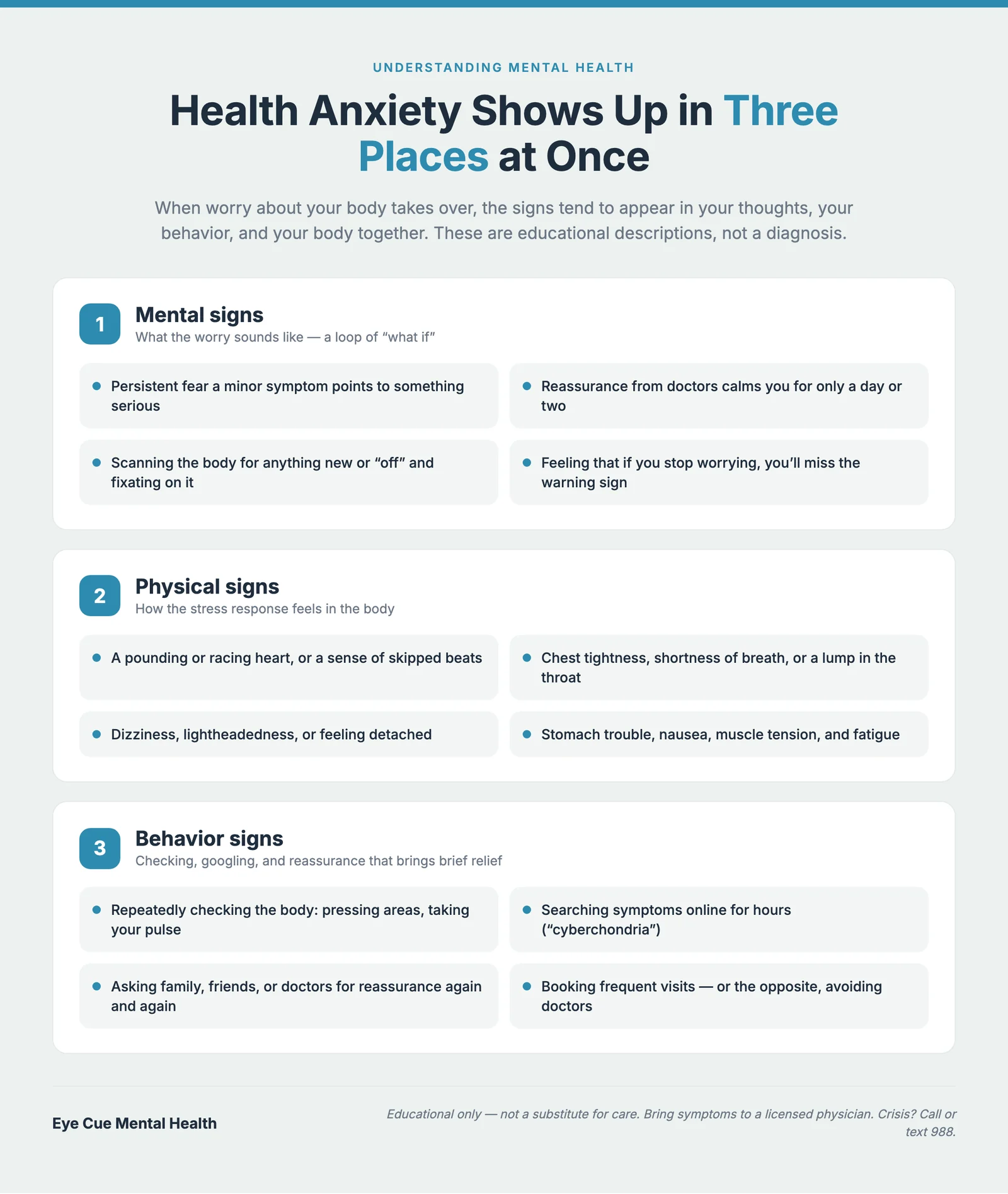
The behaviors tend to fall into a few patterns:
- Repeatedly checking the body: pressing on areas, taking your pulse, examining skin or lumps
- Searching symptoms online, sometimes for hours, a habit often called "cyberchondria"
- Asking family, friends, or doctors for reassurance again and again
- Booking frequent appointments and tests, or the opposite, avoiding doctors entirely out of fear
Each of these promises certainty and delivers a brief hit of calm. Then the doubt returns, often stronger, and the urge to check grows. Learning to gently step out of that loop is a large part of what therapy for anxiety focuses on.
Health anxiety, hypochondria, and where they overlap
The word "hypochondria" is the old, informal term for this. Clinicians today usually describe two related patterns instead, and the difference is worth knowing.
In illness anxiety disorder, the fear of being seriously ill is the main feature even though physical symptoms are mild or absent. In somatic symptom disorder, real and distressing physical symptoms are present, and the disproportionate worry about them takes over daily life. The overlap with general anxiety is common too, and the two often travel together.
You don't need to sort out the exact label yourself. That's what an assessment is for. If broad, free-floating worry is the loudest part of your experience rather than a specific illness fear, our social anxiety therapy resources and general anxiety therapy may be a better starting point. And if repetitive checking rituals sound closer to your experience, it's worth reading about the types of OCD, since the two can look similar.
One more thing I want people to hear. Living with health anxiety doesn't mean you're weak, dramatic, or "making it up." The fear is real, the sensations are real, and the exhaustion of always scanning for danger is real. In our Cerritos office and across our LA and Orange County communities, I meet thoughtful, capable people caught in this loop all the time. Naming what's happening is often the first bit of relief.
When should you talk to a professional about health anxiety?
Consider reaching out when worry about your health is taking up significant time, causing real distress, or getting in the way of work, sleep, or relationships. You don't need to wait until it feels unbearable, and you don't need a diagnosis first.
I'll say this plainly, because it matters. Getting a physical checkup and getting mental health support are not competing choices. See a physician about the symptoms themselves. If the worry keeps returning after medical causes have been addressed, that's the signal that anxiety, not the body, may be the thing to treat.
For many people, a focused course of talk therapy helps. In our practice, care usually looks like individual therapy that gradually reduces checking and reassurance behaviors and builds tolerance for uncertainty, so a normal sensation stops setting off alarm. Because we accept Medi-Cal and several private plans and offer telehealth across California as well as in-person sessions in Cerritos, it's easier to start before the worry takes up more of your day.
The questions I hear most about health anxiety symptoms, answered in plain language.
Ready to quiet the health worry? Start anxiety therapy
You don't have to keep negotiating with every ache and heartbeat on your own. If worry about your body is taking up your time and peace of mind, anxiety therapy at Eye Cue Mental Health gives you a private, structured space to step out of the checking cycle and feel steadier in your own skin. We see clients in person in Cerritos and by video across California, and we accept Medi-Cal and many private plans. Call 562-860-2891 to talk it through.
This article was reviewed by Saqib Iqbal, LCSW, founder of Eye Cue Mental Health in Cerritos, California. He opened the practice in 2017, supervises the clinical team, and reviews the practice's mental health guides for accuracy.
Frequently asked questions
What are the most common health anxiety symptoms?
In general, people describe a few recurring signs: frequent worry that ordinary body sensations mean a serious illness, repeated checking of the body for lumps or changes, and a pull to search symptoms online or ask for reassurance. Many also avoid doctors out of fear, or the opposite, book visit after visit. These are educational descriptions, not a diagnosis. A licensed clinician can tell health anxiety apart from a medical issue.
Is health anxiety the same as hypochondria?
They overlap. 'Hypochondria' is an older, informal word for intense worry about having a serious illness. Clinicians today usually describe two related patterns: illness anxiety disorder, where the fear centers on being sick despite few or no symptoms, and somatic symptom disorder, where real physical sensations drive disproportionate distress. The label matters less than whether the worry is taking over your life.
Can health anxiety cause real physical symptoms?
Yes, and this is one of the most confusing parts. Anxiety activates the body's stress response, which can produce a racing heart, chest tightness, dizziness, stomach upset, muscle tension, and fatigue. Those sensations are genuinely felt, and then they become new evidence that something is wrong, which feeds the cycle. That does not mean symptoms should be ignored. A physician should rule out medical causes first.
How do I stop constantly checking my body or googling symptoms?
Checking and searching bring a few seconds of relief, then more doubt, so the habit strengthens over time. In therapy, we work on gradually reducing those behaviors and learning to sit with uncertainty rather than chase certainty that never fully arrives. It is paced with you, not forced. Small, steady changes tend to hold better than going cold turkey overnight.
When should I talk to a therapist about health anxiety?
Consider reaching out if worry about your health is taking up significant time, driving repeated checking or reassurance-seeking, or getting in the way of work, sleep, or relationships. You do not need a formal diagnosis first. Call us at 562-860-2891 to talk it through, in person in Cerritos or by video across California.
Anxiety therapy for health worries in Cerritos and by telehealth across California, covered by Medi-Cal.
Learn moreEye Cue Mental Health is a psychotherapy practice and does not prescribe medication. This article is educational and is not a diagnosis or a substitute for professional care. Health worries can also have a medical cause, so bring symptoms to a licensed physician for evaluation. If you are in crisis, call or text 988 (Suicide and Crisis Lifeline) any time.
