


OCD, or obsessive-compulsive disorder, is a condition where unwanted intrusive thoughts (obsessions) drive repetitive behaviors or mental acts (compulsions) meant to ease the distress. It shows up in several recognizable themes, and it is far more than a preference for a tidy space. If intrusive thoughts and rituals are wearing you down, talk therapy at Eye Cue Mental Health can help, in person in Cerritos or by video across California.
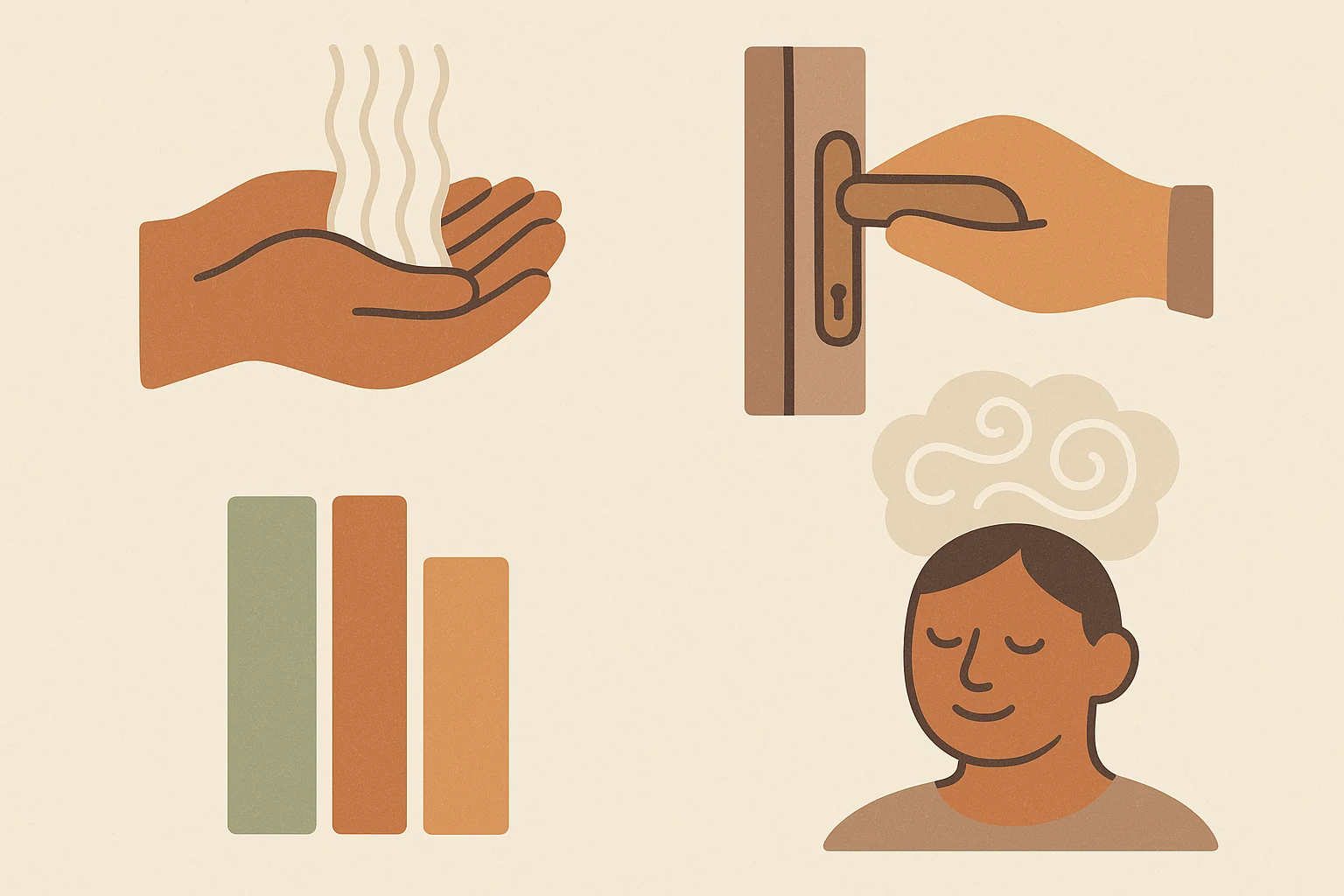
What is OCD, really?
OCD is a mental health condition built on a two-part cycle: an obsession and a compulsion. Per the National Institute of Mental Health, obsessions are recurring, unwanted thoughts, urges, or images that cause anxiety, and compulsions are the repetitive behaviors or mental acts a person feels driven to perform in response.
The compulsion brings short-term relief, which is exactly what makes it so sticky. The brain learns that the ritual "worked," so the urge to repeat it grows stronger over time. That loop, not the specific fear, is the engine of OCD.
It is worth naming a common misunderstanding. Liking a neat desk or double-checking a lock once is not OCD. The disorder involves obsessions and compulsions that are distressing, time-consuming (often more than an hour a day), and disruptive to daily life. Understanding the cycle is the first step toward interrupting it, and it is the same cycle underneath every theme below.
What are the 4 types of OCD?
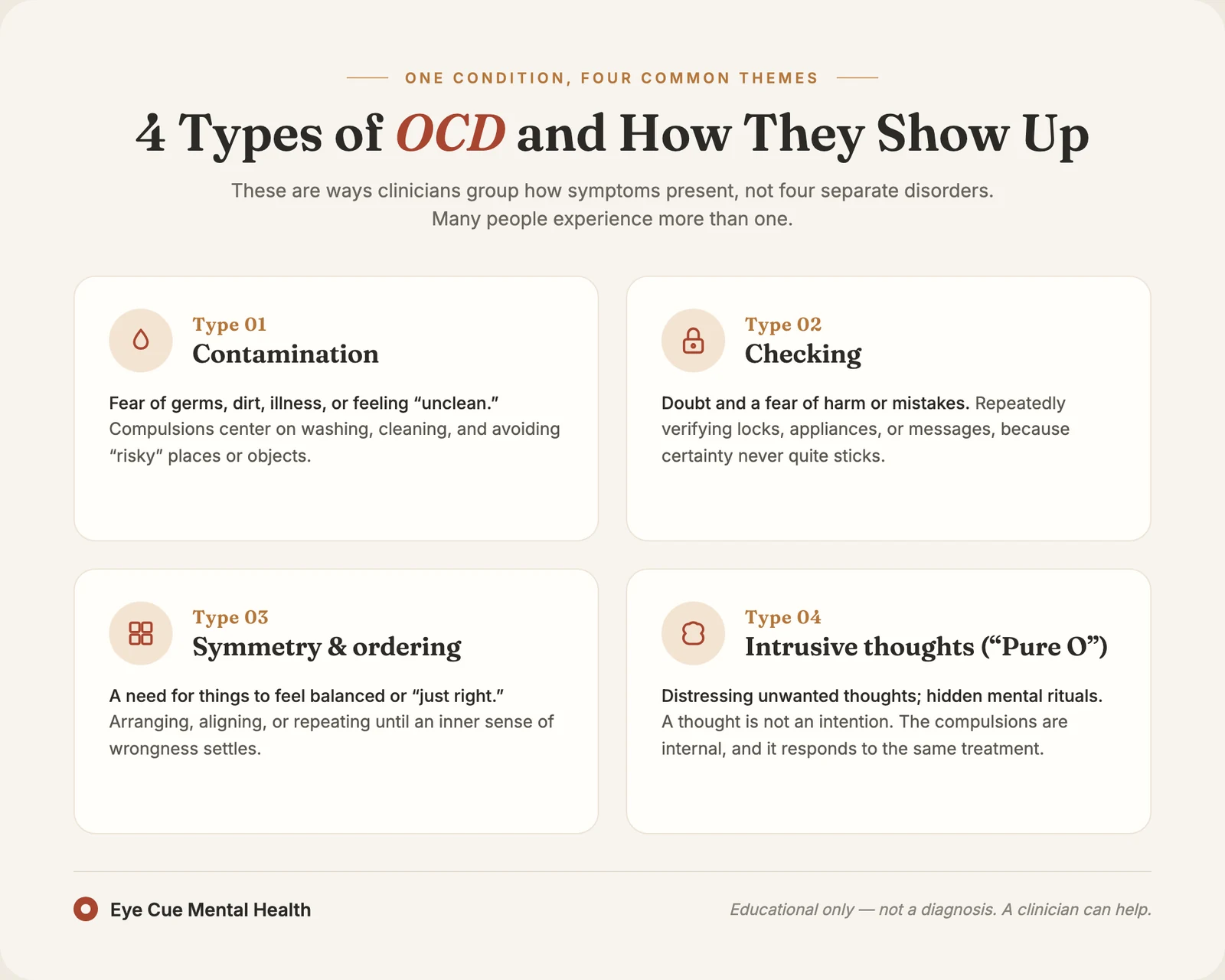
Clinicians often describe four common themes of OCD: contamination, checking, symmetry and ordering, and intrusive or taboo thoughts. According to the International OCD Foundation, these are ways of grouping how symptoms present, not four separate disorders. OCD is a single condition, and many people move between themes over their lifetime or experience several at once.
Use these categories as a map, not a box. The point is to recognize the obsession-and-compulsion pattern in your own experience, whatever the specific fear happens to be. Here is how each theme tends to show up.
1. Contamination OCD
Contamination OCD centers on a fear of germs, dirt, illness, or being "unclean," with compulsions built around washing and avoiding. This is the theme most people picture, and it is common, but it is only one of several. The obsession might be catching an illness, spreading it to a loved one, or a broader sense of feeling tainted.
The compulsions often include excessive hand-washing, showering, or cleaning; avoiding public restrooms, doorknobs, or "risky" places; and elaborate routines for laundry or food. Some people experience emotional or mental contamination, where a feeling of being dirty comes from an idea or a person rather than an actual substance. When day-to-day worry and avoidance feel wrapped up in this, our anxiety therapy team works with exactly this kind of fear-and-avoidance loop.
2. Checking OCD
Checking OCD is driven by doubt and a fear of harm, causing a person to repeatedly verify that something is safe. The core obsession is often "what if I made a terrible mistake?" or "what if I hurt someone by being careless?" The doubt never fully resolves, so the checking repeats.
Common compulsions include checking locks, the stove, or appliances again and again; re-reading emails for fear of a mistake; repeatedly confirming you did not hit someone while driving; or seeking reassurance from others. A hallmark of this theme is that certainty never sticks. Even after checking ten times, the doubt creeps back, which is why the goal in therapy is learning to tolerate uncertainty rather than chase it away.
3. Symmetry and ordering OCD
Symmetry and ordering OCD involves a need for things to feel balanced, even, or "just right," with compulsions to arrange, align, or repeat until the feeling settles. Unlike contamination, the drive here is often not about preventing a specific catastrophe. It is about relieving an intense sense of internal wrongness.
You might see this as arranging objects until they are perfectly aligned, counting or repeating actions a certain number of times, or redoing a task until it feels complete. Some people also experience "magical thinking," a fear that if things are not ordered correctly, something bad will happen to them or someone they love. The relief is real but brief, which keeps the cycle turning.
4. Intrusive thoughts, or "Pure O"
Intrusive-thought OCD, informally called "Pure O," centers on disturbing unwanted thoughts, with compulsions that are mostly mental and hidden. Per the International OCD Foundation, these obsessions can involve violent, sexual, or blasphemous images, or fears about one's own identity or relationships, and they are deeply distressing precisely because they clash with the person's values.
Here is the most important thing to understand: an intrusive thought is not an intention, and having one does not mean you want it or will act on it. People with this theme are typically horrified by their thoughts, which is the opposite of a genuine desire. Because there is no visible ritual, "Pure O" is often missed, but the compulsions are still there. They are just internal: mental reviewing, silently arguing with the thought, seeking reassurance, or avoiding triggers. It is not truly "purely obsessional," and it responds to the same treatment as any other theme.
How is OCD diagnosed and distinguished from anxiety?
OCD is diagnosed by a clinician who looks for the specific pattern of obsessions and compulsions, not just general worry. Per the American Psychiatric Association's DSM-5, a diagnosis involves obsessions, compulsions, or both that are time-consuming or cause significant distress or impairment. Applying that to your own experience means noticing the loop, not just the anxiety.
The overlap with anxiety disorders is real, and the two often co-occur. The distinguishing feature of OCD is the compulsion: a specific, repetitive behavior or mental act performed to neutralize an obsession. General anxiety tends to involve broad, free-floating worry without that ritualized response. A clinician can tell them apart in an assessment, which matters because it shapes the plan. If worry without clear rituals is the loudest part of your experience, our anxiety therapy page may be a better starting point, and for teens navigating these patterns, teen therapy is built for that stage of life.
How is OCD treated?
OCD is treated first with a specific form of psychotherapy called Exposure and Response Prevention (ERP). Per the American Psychological Association, exposure-based therapy helps a person gradually face the feared thought or situation while resisting the usual compulsion, so the anxiety can rise and then fall on its own without the ritual.
Over time, ERP teaches the nervous system that the feared outcome does not happen and that uncertainty is survivable, which slowly loosens the grip of the cycle. It is structured, collaborative, and paced with you. A well-trained clinician does not throw you into your worst fear on day one; you build up gradually.
At Eye Cue Mental Health, care for OCD symptoms usually looks like a focused course of individual therapy grounded in these evidence-based methods. Because we accept Medi-Cal and several private plans, and offer telehealth across California as well as in-person sessions in Cerritos, it is easier to start before the rituals take up more of your day. Medication is sometimes part of an OCD care plan; as a psychotherapy practice we do not prescribe, but we help coordinate with an outside prescriber when it makes sense.
The questions we hear most about the types of OCD, answered in plain language.
Ready to quiet the cycle? Start therapy for OCD symptoms
You do not have to keep negotiating with intrusive thoughts on your own. If obsessions and compulsions are taking up your time and energy, talk therapy at Eye Cue Mental Health gives you a private, structured space to interrupt the cycle and get your day back. We see clients in person in Cerritos and by video across California, and we accept Medi-Cal and many private plans. Call 562-860-2891 to talk it through.
This article was reviewed by Saqib Iqbal, LCSW, founder of Eye Cue Mental Health in Cerritos, California. He supervises the clinical team and reviews the practice's mental health guides for accuracy.
Frequently asked questions
What are the 4 main types of OCD?
Clinicians often group common OCD presentations into four themes: contamination (fear of germs, illness, or dirt), checking (doubt about safety or harm), symmetry and ordering (a need for things to feel 'just right'), and intrusive or taboo thoughts, sometimes called 'Pure O.' These are descriptive themes, not separate diagnoses. OCD is one condition, and many people experience more than one theme at once.
Is OCD just about being clean or organized?
No. Contamination and ordering are two common themes, but OCD can center on almost any fear, including harm, religion, relationships, or sexuality. Casually calling yourself 'so OCD' about a tidy desk is different from the disorder, which involves distressing, unwanted obsessions and time-consuming compulsions that interfere with daily life.
What is 'Pure O' OCD?
'Pure O' is an informal term for OCD where the compulsions are mostly mental rather than visible. A person may have distressing intrusive thoughts and respond with hidden rituals like mental reviewing, reassurance-seeking, or silent counting. It is not a separate diagnosis, and it is not truly 'purely obsessional,' because the mental rituals are still compulsions.
Can OCD be treated without medication?
Yes. A specific form of talk therapy called Exposure and Response Prevention (ERP), a type of cognitive behavioral therapy, is considered a first-line treatment for OCD. Eye Cue Mental Health is a psychotherapy practice and does not prescribe medication; if a prescriber's input is worth considering, we help coordinate that with an outside provider.
When should I talk to a therapist about OCD?
Consider reaching out if intrusive thoughts or repetitive behaviors are taking up significant time, causing real distress, or getting in the way of work, school, or relationships. You do not need a formal diagnosis first, and you do not have to wait until it feels unbearable. Call us at 562-860-2891 to talk it through.
Talk therapy for OCD symptoms in Cerritos and by telehealth across California, covered by Medi-Cal.
Learn moreEye Cue Mental Health is a psychotherapy practice and does not prescribe medication. This article is educational and is not a diagnosis or a substitute for professional care. If you are in crisis, call or text 988 (Suicide and Crisis Lifeline) any time.
