


I'm Saqib Iqbal, LCSW, and I founded Eye Cue Mental Health in Cerritos to make good therapy reachable for our community. The question I hear more than almost any other is some version of "is this just stress, or is something actually wrong?" If you've asked yourself that, anxiety therapy at Eye Cue Mental Health can help you sort it out, in person in Cerritos or by video across California.
What's the difference between anxiety and stress?
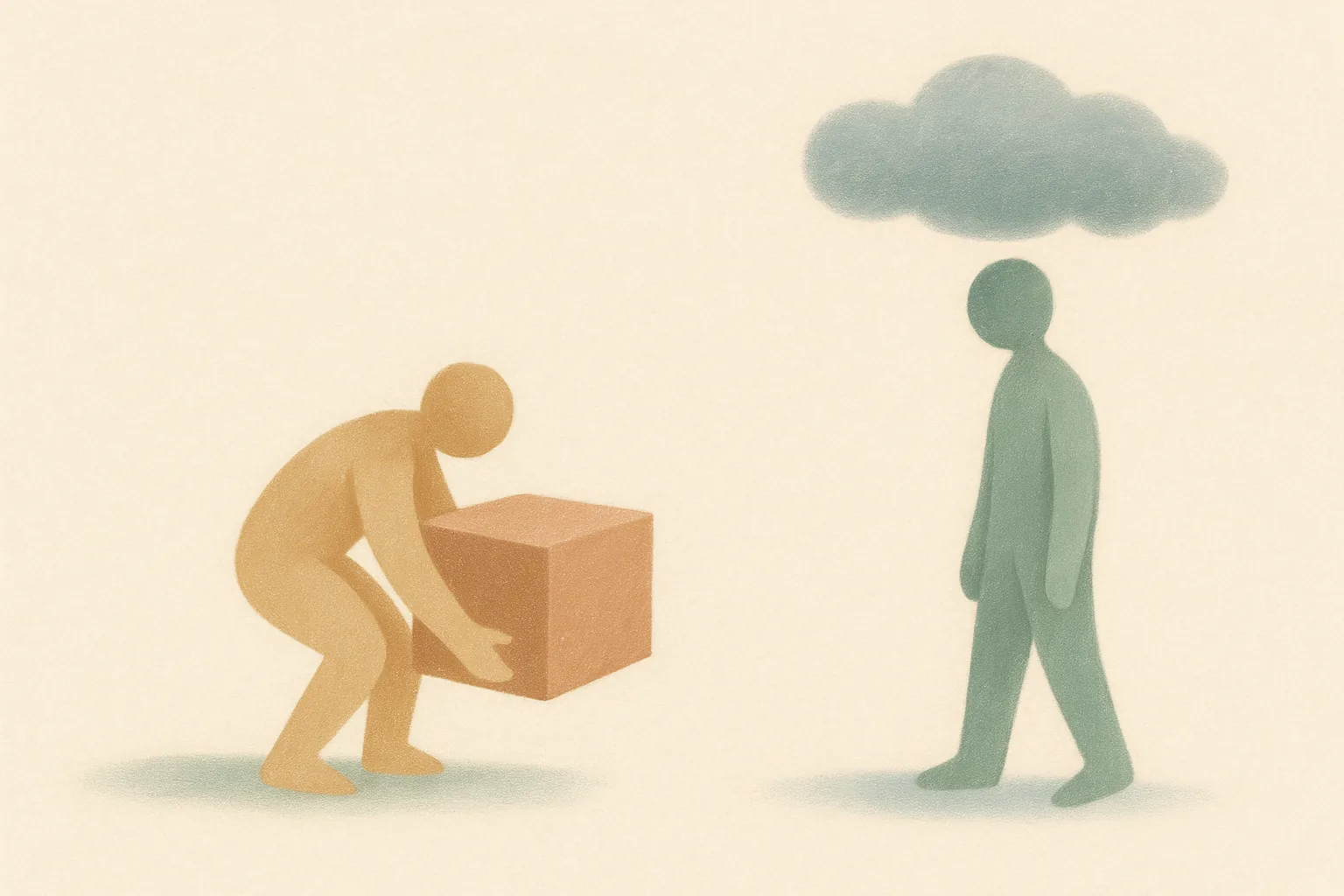
The main difference is timing and trigger: stress is a reaction to an outside pressure and usually eases once that pressure lifts, while anxiety tends to linger and can show up even when nothing is wrong. According to the American Psychological Association, stress is typically caused by an external trigger and fades when the situation resolves, whereas anxiety is persistent worry that continues even without a clear stressor.
So a helpful test is to ask what happens after the hard thing is over. If the tension drains away once the deadline passes or the argument ends, that reads more like stress. If the worry sticks around, or your mind just moves to the next thing to fear, that leans more toward anxiety.
I'll say this early, because it matters: this article is educational, not a diagnosis. Only a licensed clinician can tell you what's really going on for you. What I can do here is give you a clearer map, so the question feels less confusing.
What stress feels like, and why it isn't the enemy
Stress is your body's response to a demand or a threat, and in the short term it's actually doing its job. When you face a challenge, your nervous system revs up so you can meet it. For many people, that jolt is what helps you hit the deadline, prep for the interview, or handle an emergency.
Stress usually has a clear cause you can name. A packed week, a move, a sick family member, money pressure, a hard conversation coming up. And it usually has an endpoint. When the pressure eases, so does the feeling.
Common signs of short-term stress include:
- Tension in your neck, shoulders, or jaw
- Trouble sleeping the night before something big
- Irritability or a shorter fuse than usual
- Racing thoughts about the specific thing you have to handle
- A stomach that feels off before a stressful event
The trouble starts when stress never gets to switch off. Ongoing pressure with no recovery, what many clinicians call chronic stress, wears the body down and can feed into anxiety over time. That's a common path, not a guarantee, and it's one reason not to just wait it out indefinitely.
What anxiety feels like, and how it's different
Anxiety is persistent worry or fear that often outlasts the trigger, or shows up without an obvious one. Per the National Institute of Mental Health, anxiety disorders involve worry or fear that does not go away and can get worse over time, interfering with daily activities like work, school, and relationships.
Here's the shift I want you to notice. With stress, your mind is usually stuck on a real, present problem. With anxiety, the mind often jumps to what-ifs, worst cases, and things that haven't happened and may never happen. The alarm keeps ringing after the fire is out.
Anxiety tends to show up as some mix of the following:
- Worry that's hard to turn off, even when you tell yourself to relax
- Feeling on edge, restless, or keyed up
- Trouble concentrating because your mind keeps wandering to fears
- Physical symptoms like a racing heart, tight chest, or nausea with no clear cause
- Avoiding situations because of what might happen
- Sleep that suffers even on nights with nothing "big" the next day
One more thing worth naming. A little anxiety is part of being human, the same way a little stress is. The concern is less about feeling it at all and more about how often, how intensely, and whether it starts steering your choices.
Anxiety vs. stress: a quick comparison
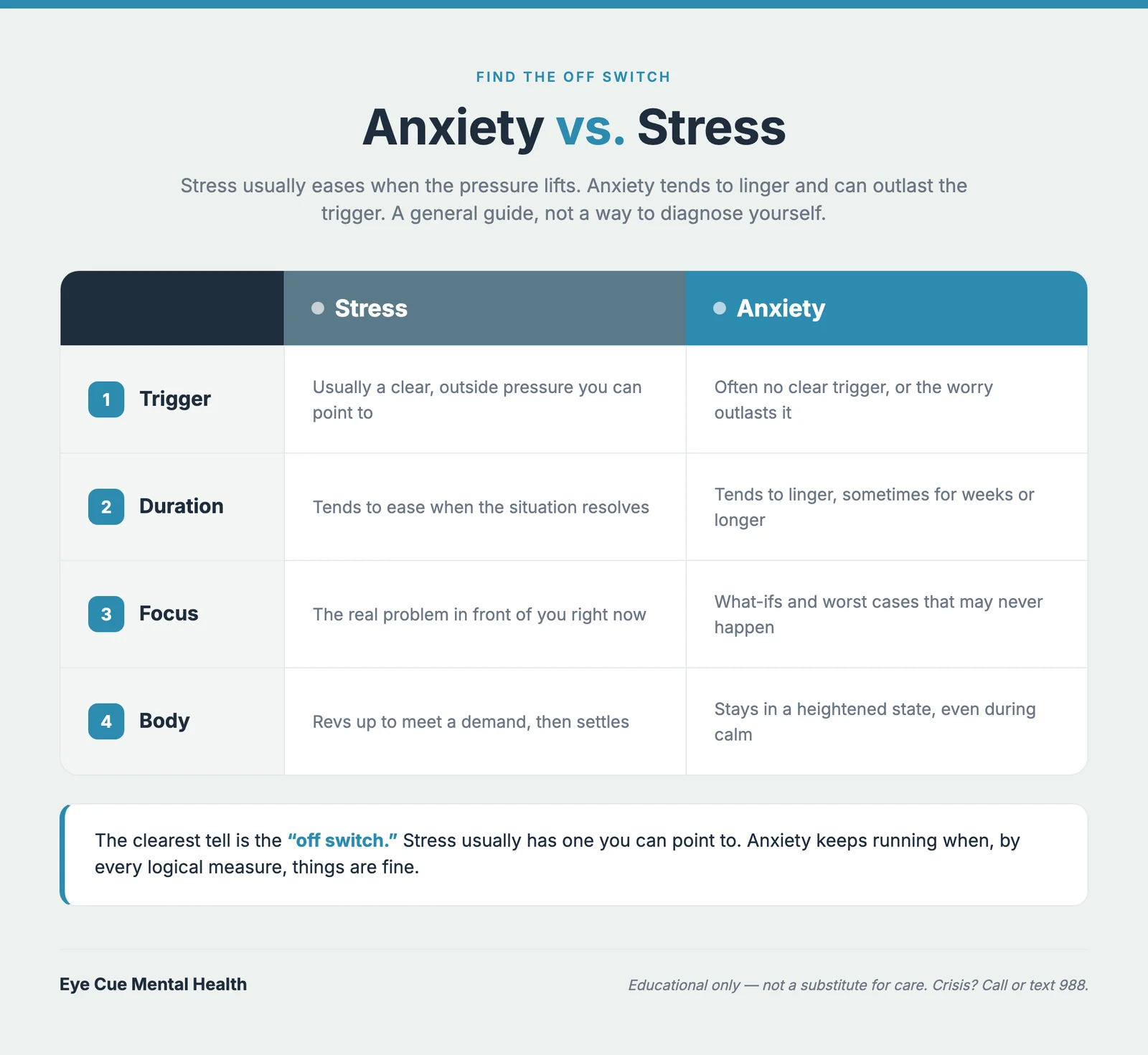
Sometimes it helps to see the two lined up. Use this as a general guide, not a checklist to diagnose yourself.
| Stress | Anxiety | |
|---|---|---|
| Trigger | Usually a clear, outside pressure | Often no clear trigger, or the worry outlasts it |
| Duration | Tends to ease when the situation resolves | Tends to linger, sometimes for weeks or longer |
| Focus | The real problem in front of you | What-ifs and worst cases that may never happen |
| Body | Revs up to meet a demand, then settles | Stays in a heightened state, even during calm moments |
The clearest tell, in my experience, is the "off switch." Stress has one you can usually point to. Anxiety keeps running when, by every logical measure, things are fine.
Why the line between them gets blurry
For many people, stress and anxiety overlap, and long stretches of stress can contribute to anxiety over time. When the body stays in a heightened state without recovery, worry can become a well-worn habit that keeps going after the original pressure is gone. That's part of why the two get confused so often.
Culture plays a role too. In a lot of the families I work with across our immigrant and multicultural communities, there's real pressure to carry stress quietly and push through. That can make it harder to notice when everyday stress has quietly shifted into something more persistent. Naming it isn't weakness. It's information.
If you're reading this and can't tell which one you're dealing with, that's genuinely okay. You don't need to have it figured out before you reach out. Sorting it out is part of what a first conversation with a clinician is for.
When to talk to a therapist about anxiety or stress
In general, it's worth reaching out when stress or anxiety lasts for weeks, feels bigger than the situation, or starts affecting your sleep, focus, or relationships. Per the National Institute of Mental Health, anxiety disorders are among the most common mental health conditions, and they are treatable, so worry that keeps interfering with daily life is worth talking through with a clinician.
You do not need a diagnosis first, and you do not have to wait until things feel unbearable. Some signs it's worth talking to someone:
- The worry is frequent and hard to control
- It's been going on for weeks rather than a rough few days
- It's showing up in your body: sleep, appetite, chest, stomach
- You're avoiding people, places, or tasks to keep it at bay
- It's affecting your work, school, or relationships
If your worry doesn't come with the clear rituals of obsessive-compulsive patterns but is more of a broad, free-floating hum, general anxiety support is usually the right starting point. If you'd like to understand a related pattern, our guide to the 4 types of OCD walks through how compulsions differ from ordinary worry. And if social situations are the sharpest edge of it, our page on social anxiety therapy speaks directly to that.
At Eye Cue Mental Health, anxiety care usually looks like a focused course of talk therapy, often drawing on cognitive behavioral methods that help you respond differently to worry rather than get pulled around by it. Because we accept Medi-Cal and several private plans, and offer telehealth across California alongside in-person sessions in Cerritos, it's easier to start before stress and worry take up more of your days. If low mood is tangled up with the worry, depression therapy may be part of the picture too.
The questions I hear most about anxiety and stress, answered in plain language.
Not sure which one it is? Let's figure it out together
You don't have to diagnose yourself before you reach out, and you don't have to wait until it's a crisis. If stress or worry has been running longer or louder than it should, anxiety therapy at Eye Cue Mental Health gives you a calm, private place to understand what's happening and build tools that actually help. We see clients in person in Cerritos and by video across California, and we accept Medi-Cal and many private plans. Call 562-860-2891 to talk it through.
This article was written and reviewed by Saqib Iqbal, LCSW, founder of Eye Cue Mental Health in Cerritos, California. He supervises the clinical team and reviews the practice's mental health guides for accuracy.
Frequently asked questions
What is the main difference between anxiety and stress?
Stress is a response to an outside pressure and usually eases once that pressure lifts, like after a deadline passes. Anxiety often lingers and can show up with no clear trigger, or it stays long after the stressful event is over. In general, stress has an off switch you can point to, while anxiety keeps the alarm running even when things are calm.
Can stress turn into anxiety?
For many people, ongoing or intense stress can contribute to anxiety over time, though stress and anxiety are not the same thing. When the body stays in a heightened state for long stretches, worry can become a habit that outlasts the original pressure. This is not a rule for everyone, and a licensed clinician can help sort out what is happening for you specifically.
How do I know if my anxiety is a problem?
In general, it may be worth talking to a clinician when worry is frequent, feels hard to control, and gets in the way of work, sleep, relationships, or daily life. You do not need a formal diagnosis or a crisis to reach out. A licensed clinician can help you understand what you are experiencing and whether support would help.
Is some anxiety normal?
Yes. Occasional worry before a test, a big meeting, or a hard conversation is a normal part of being human, and short-lived stress can even sharpen focus. The concern is less about feeling anxious at all and more about how often it happens, how intense it gets, and whether it starts running your day. When it does, support can help.
When should I talk to a therapist about anxiety or stress?
Consider reaching out if stress or anxiety is lasting weeks, feels bigger than the situation, or is affecting sleep, focus, or your relationships. You do not have to wait until it feels unbearable. Call us at 562-860-2891 to talk it through, or reach out any time you want a place to start.
Anxiety therapy in Cerritos and by telehealth across California, covered by Medi-Cal.
Learn moreEye Cue Mental Health is a psychotherapy practice. This article is educational and is not a diagnosis or a substitute for professional care. If you are in crisis, call or text 988 (Suicide and Crisis Lifeline) any time.
