


For a lot of women, ADHD does not look like the fidgety kid in the back of class. It looks like exhaustion, chronic lateness, a mind that will not quiet down, and years of quietly wondering why everything feels harder for you than it seems to be for everyone else. I'm Saqib Iqbal, LCSW, and this is one of the most common patterns I sit with in my office. If it sounds familiar, ADHD therapy for women at Eye Cue Mental Health can help, in person in Cerritos or by video across California.
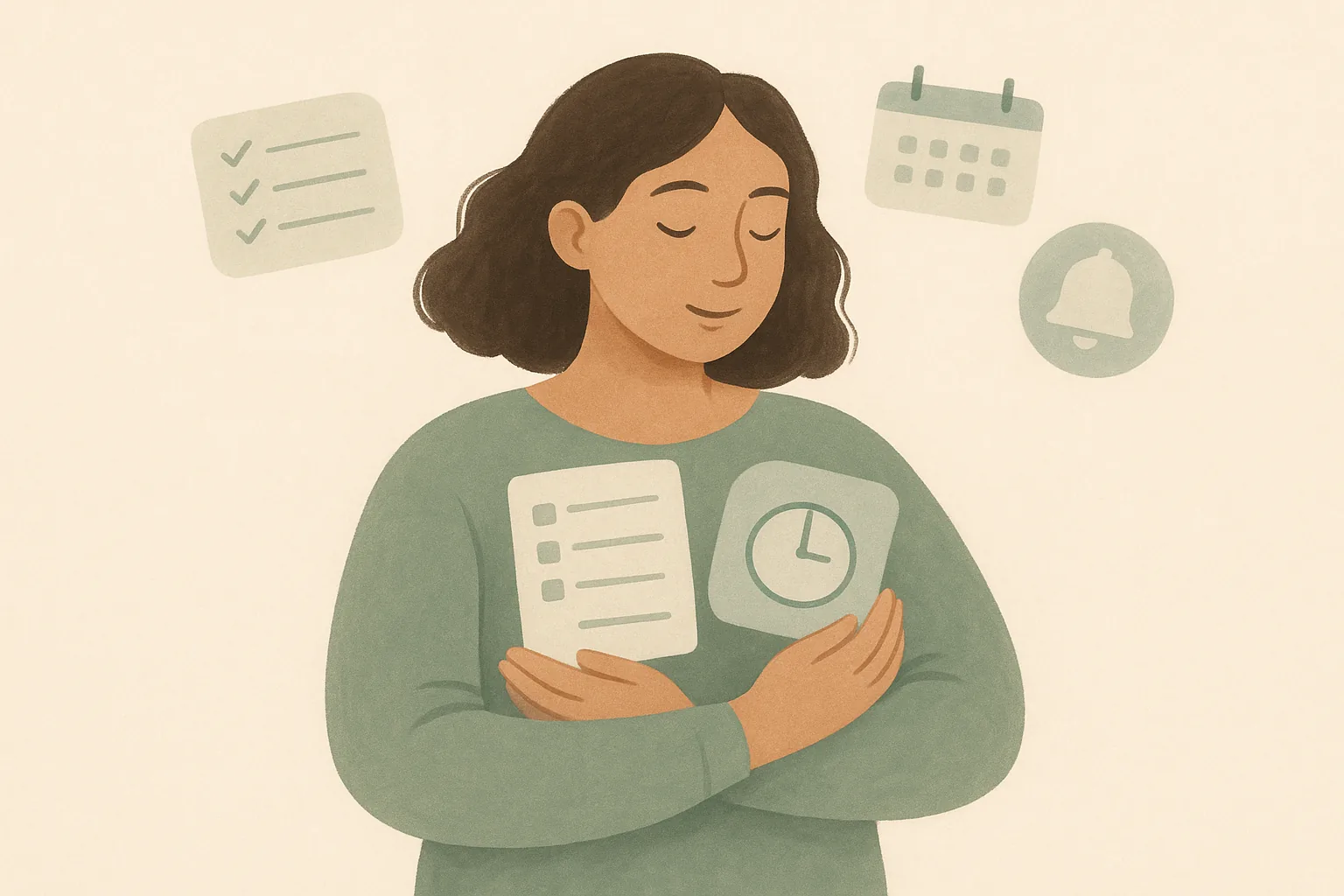
Why is ADHD so often missed in women?
ADHD is missed in women because the whole picture of the condition was built around hyperactive young boys, and women more often have the quieter, inattentive kind. Per the Centers for Disease Control and Prevention, boys are more likely to be diagnosed with ADHD than girls, a gap driven partly by how differently symptoms present. Because the inattentive pattern does not disrupt a classroom, it rarely gets flagged.
So the symptoms are there. They just do not match the stereotype anyone is looking for. Instead of climbing the walls, a girl with ADHD is more likely to be the daydreamer staring out the window, the one who "has so much potential" but forgets her homework, the sensitive kid who cries easily. None of that gets a referral.
That means many women grow up absorbing a different message entirely. Not "you have a condition," but "you are lazy, disorganized, too sensitive, or not trying hard enough." Those labels stick, and they shape how a woman sees herself long into adulthood.
What does ADHD look like in women?
In women, ADHD usually shows up as internal overwhelm rather than external hyperactivity: a racing mind, chronic disorganization, running late, forgetfulness, emotional intensity, and deep exhaustion from holding it together. Per the National Institute of Mental Health, the inattentive presentation involves trouble sustaining attention, following through, and staying organized, without the obvious physical restlessness.
I want to be clear about something. These are not personality flaws. They are a well-documented pattern of how attention and self-regulation work. Here is how it tends to look in the women I work with.
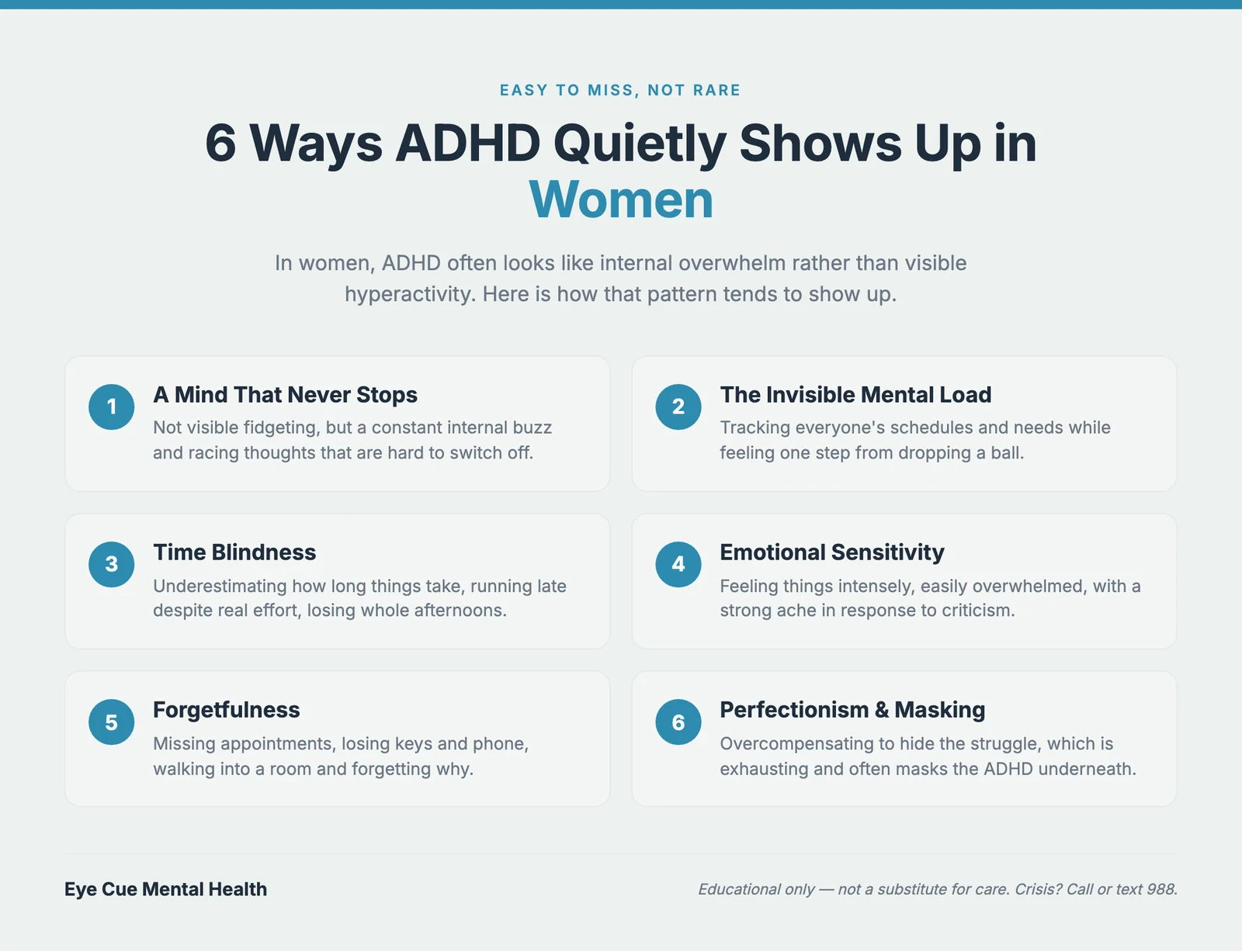
- A mind that never stops. Not visible fidgeting, but a constant internal buzz, racing thoughts, and real difficulty switching off or resting.
- The invisible mental load. Tracking everyone's schedules, appointments, and needs while feeling like you are always one step from dropping a ball.
- Time blindness. Underestimating how long things take, running late despite genuine effort, or losing whole afternoons.
- Emotional sensitivity. Feeling things intensely, being easily overwhelmed, and a strong ache in response to criticism or perceived rejection.
- Forgetfulness. Missing appointments, losing your keys and phone, walking into a room and forgetting why.
- Perfectionism and people-pleasing. Overcompensating to hide the struggle, which is exhausting and often masks the ADHD underneath.
If several of these have been a theme for as long as you can remember, that is worth paying attention to. Our individual therapy team works with women navigating exactly this kind of overwhelm.
What is masking, and why does it hide ADHD in women?
Masking is the effort of hiding ADHD symptoms behind coping systems, apologies, and overwork so you appear to be keeping up. It is exhausting, and it is a big reason ADHD in women stays hidden for so long. Many women get very good at looking fine while feeling like they are barely holding on underneath.
Masking looks like color-coded calendars, endless lists, arriving early to hide a tendency to run late, and rehearsing conversations in advance. It works, for a while. The problem is that it costs enormous energy and it hides the very symptoms a clinician would use to recognize the pattern.
Then a season of life gets harder. A new job, a baby, a sick parent, or the hormonal shift of perimenopause, and suddenly the old systems cannot keep up. The mask slips, the overwhelm floods in, and many women arrive at that point convinced something is deeply wrong with them, when the real story is an unrecognized condition finally becoming visible.
Why is ADHD in women confused with anxiety and depression?
ADHD in women is often confused with anxiety and depression because they look similar on the surface and frequently occur together. Per CHADD, a leading ADHD education organization, ADHD commonly coexists with anxiety and mood disorders, and the overlapping conditions can obscure the underlying ADHD.
Picture the sequence. A woman who has struggled with focus and follow-through her whole life feels chronically behind, judges herself harshly, and lives braced for the next dropped ball. That reasonably produces anxiety and low mood. So the anxiety or depression gets diagnosed and treated first, which is not wrong, but the ADHD driving a lot of it stays invisible.
This matters for treatment. When you treat the anxiety without recognizing the ADHD underneath, the anxiety tends to keep coming back, because its root cause is still unaddressed. If low mood or worry has been part of your experience, our pages on anxiety therapy and depression therapy explain how those threads connect, and a clinician can help untangle which is which.
Do hormones affect ADHD symptoms in women?
Many women notice their focus and emotional regulation shift with their hormones, and research increasingly supports a real connection. Per the Cleveland Clinic, estrogen influences dopamine, the brain chemical closely tied to attention and motivation, so ADHD symptoms can feel more intense when estrogen levels fall.
In practice, that means some women feel their symptoms worsen in the days before their period, and again during pregnancy, postpartum, and perimenopause, when estrogen drops significantly. This is still an active area of study, so I hold it as a pattern worth watching rather than a settled fact. What matters clinically is simple: if your struggles rise and fall with your cycle or a hormonal transition, that is real information, and it is worth raising with a clinician who understands both ADHD and hormonal health.
Why do so many women get diagnosed later in life?
Women are frequently diagnosed with ADHD in adulthood because they spent years compensating, and the diagnostic system was not looking for them as girls. A later diagnosis is common, valid, and often a genuine relief. It is not a sign you imagined the struggle or that it is "too late" to help.
Sometimes the recognition comes sideways. A woman brings her child in for an ADHD evaluation, hears the clinician describe the pattern, and thinks: that is me, that has always been me. Other times it is a demanding season that finally overwhelms the coping systems that held for decades.
Whatever the path, the diagnosis reframes a lifetime of self-blame into something workable. You were not failing at a life everyone else found easy. You were doing it without the right map. This same late-diagnosis pattern shows up across adulthood, which I write about in our guide on the signs of ADHD in adults.
How is ADHD in women treated?
ADHD in women is treated with practical skill-building, therapy, and, for some, medication managed by a prescriber. Per the American Psychological Association, behavioral and cognitive behavioral approaches help adults build concrete strategies for organization, time management, and emotional regulation.
Therapy does something medication alone cannot: it helps you build a life around how your brain actually works instead of forcing it into systems that were never designed for you. That includes breaking overwhelming tasks down, managing the emotional weight, easing the perfectionism and people-pleasing, and, honestly, learning to stop treating every slip as proof you are broken.
At Eye Cue Mental Health, ADHD therapy for women draws on Cognitive Behavioral Therapy and solution-focused methods to build exactly those skills. We do not provide formal neuropsychological testing or prescribe medication; if you need formal testing we point you to the right provider, and if you work with a prescriber we coordinate with them. Because we accept Medi-Cal and several private plans, and offer telehealth across California as well as in-person sessions in Cerritos, it is easier to start before the next hard season stretches you thin.
One thing I will not do is diagnose you from a blog post. What I can tell you is that a proper assessment with a qualified clinician is the right next step, not a quiz you found online.
The questions we hear most about ADHD in women, answered in plain language.
Ready to stop white-knuckling it? Start ADHD therapy
You do not have to keep running yourself ragged to look like you have it together. If focus, overwhelm, and years of being hard on yourself have been a long-standing pattern, ADHD therapy for women at Eye Cue Mental Health gives you practical, personalized tools that fit how your mind actually works. We see clients in person in Cerritos and by video across California, and we accept Medi-Cal and many private plans. Call 562-860-2891 to talk it through.
This article was reviewed by Saqib Iqbal, LCSW, founder of Eye Cue Mental Health in Cerritos, California. He supervises the clinical team and reviews the practice's mental health guides for accuracy.
Frequently asked questions
Why is ADHD so often missed in women?
For decades, ADHD research and the classic picture of it were built around hyperactive young boys. Women and girls more often have the inattentive presentation, which looks like daydreaming, disorganization, and forgetfulness rather than visible restlessness. That quieter pattern gets read as anxiety, being scattered, or trying harder, so it slips past teachers, doctors, and the women themselves.
What does ADHD look like in women specifically?
In women it often shows up as chronic overwhelm, mental restlessness, running late, losing track of tasks, emotional sensitivity, and exhaustion from constantly holding it all together. Many women also mask, building elaborate systems to look organized while feeling like they are barely keeping up underneath. It frequently coexists with anxiety, low self-esteem, and burnout.
Can ADHD symptoms change with hormones or the menstrual cycle?
Many women report that their focus and emotional regulation shift across the menstrual cycle and during major hormonal transitions like pregnancy, postpartum, and perimenopause. Estrogen appears to interact with attention and mood, so symptoms can feel worse when estrogen drops. This is an active area of research, and it is worth raising with a qualified clinician who understands both ADHD and hormonal health.
Why do so many women get diagnosed with ADHD later in life?
Many women reach adulthood having compensated for years, until a demanding season like a career, parenting, or perimenopause outpaces their coping strategies and the underlying pattern surfaces. Some recognize themselves only after a child is diagnosed. A later diagnosis is common and valid, and it often brings real relief and a kinder way of understanding a lifelong struggle.
When should I talk to someone about possible ADHD?
Consider reaching out if attention, organization, follow-through, or emotional overwhelm have been a long-standing pattern across most of your life, not just a hard few weeks. You do not need a diagnosis first, and you do not have to prove your struggle is 'bad enough.' Call us at 562-860-2891 to talk it through.
ADHD therapy for women in Cerritos and by telehealth across California, covered by Medi-Cal.
Learn moreEye Cue Mental Health is a psychotherapy practice and does not prescribe medication or provide formal ADHD testing. This article is educational and is not a diagnosis or a substitute for professional care. If you are in crisis, call or text 988 (Suicide and Crisis Lifeline) any time.
