


ADHD in adults often looks nothing like the hyperactive child stereotype. Instead, it tends to show up as overwhelm, missed deadlines, forgetfulness, and a quiet mental restlessness that gets written off as stress or a personal failing. If any of that sounds familiar, ADHD therapy for adults at Eye Cue Mental Health can help you build focus and follow-through, in person in Cerritos or by video across California.
What does ADHD look like in adults?
Adult ADHD is a pattern of ongoing inattention, disorganization, or restlessness that interferes with daily functioning, and it usually looks more subtle than it does in kids. Per the National Institute of Mental Health, the obvious physical hyperactivity often fades with age, while difficulties with attention, organization, and impulse control tend to persist into adulthood.
The result is a condition that hides in plain sight. Instead of bouncing off the walls, an adult with ADHD might feel a constant hum of internal restlessness, struggle to start boring-but-important tasks, or lose track of time completely. These experiences are easy to reframe as character flaws (lazy, flaky, scattered) rather than recognized as symptoms of a well-documented neurodevelopmental condition.
That reframing matters because it changes how you treat yourself. Understanding the pattern is not about making excuses. It is about finally addressing the right problem with the right tools.
What are the signs of ADHD in adults you might overlook?
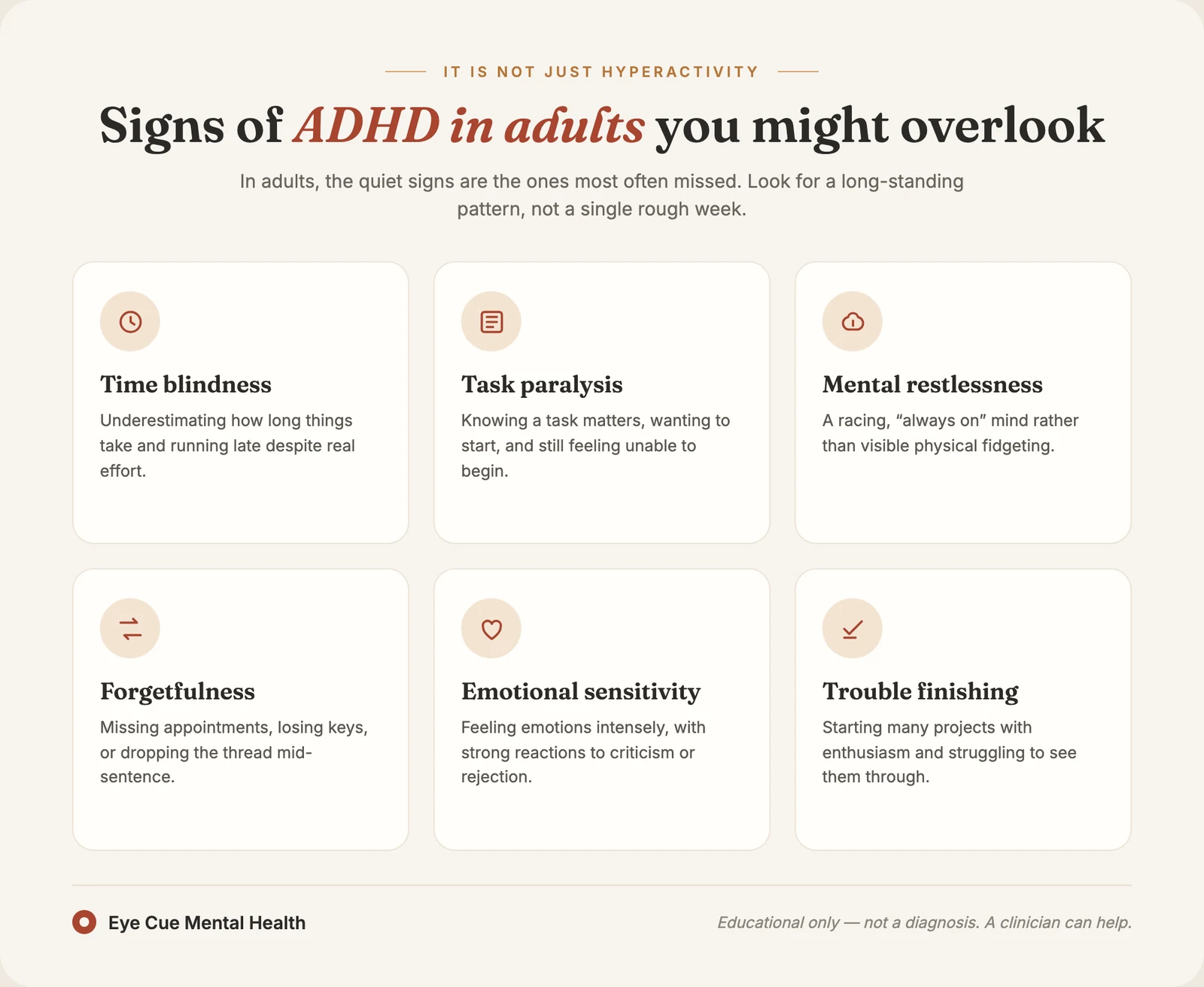
The most overlooked signs of adult ADHD are the quiet ones: mental restlessness, task paralysis, time blindness, emotional sensitivity, and chronic overwhelm. According to the Centers for Disease Control and Prevention, ADHD symptoms fall into inattentive and hyperactive-impulsive patterns, and in adults the inattentive side is often what goes unnoticed for years.
Watch for a long-standing pattern across several of these, not a single hard week:
- Time blindness. Chronically underestimating how long things take, running late despite real effort, or losing hours without noticing.
- Task paralysis. Wanting to start something, knowing it matters, and still feeling unable to begin, often followed by a last-minute sprint.
- Mental restlessness. Not physical fidgeting, but a racing or "always on" mind, difficulty relaxing, or jumping between thoughts.
- Forgetfulness. Missing appointments, losing keys and phones, forgetting why you walked into a room, or dropping the thread mid-conversation.
- Emotional sensitivity. Feeling emotions intensely, being easily frustrated or overwhelmed, or a strong reaction to perceived rejection or criticism.
- Trouble with follow-through. Starting many projects with enthusiasm and struggling to finish, or a home full of half-done tasks.
- Hyperfocus. Locking so deeply into something interesting that everything else, including meals and time, disappears.
If several of these have been a theme for as long as you can remember, it is worth talking to someone. Our individual therapy team works with adults navigating exactly this kind of focus-and-follow-through struggle.
Why does ADHD go undiagnosed in adults?
ADHD is often missed in adults because the diagnostic picture people carry in their heads is a hyperactive young boy, not a struggling adult. Per CHADD, a leading ADHD education organization, many adults were never identified in childhood, especially those with the inattentive presentation and those who were girls, because their symptoms were quieter and easier to overlook.
Two forces keep it hidden. First is masking: intelligent, capable adults build elaborate systems, lists, and workarounds that compensate for years, until a life change like a new job, a baby, or a demanding season overwhelms those systems and the underlying pattern surfaces. Second is overlap. ADHD frequently co-occurs with anxiety and depression, and those conditions can get diagnosed first while the ADHD driving them goes unnoticed. If low mood or worry has been part of your experience, our pages on anxiety therapy and depression therapy explain how those threads connect.
A clinician sorts this out through assessment, and untangling it is genuinely useful. Treating anxiety without recognizing the ADHD underneath it often means the anxiety keeps coming back.
Is it ADHD or just stress and burnout?
Distinguishing ADHD from ordinary stress comes down to pattern and timeline: ADHD is a long-standing, pervasive pattern, while stress and burnout are usually tied to a period or a situation. Per the American Psychiatric Association, several symptoms must have been present before age 12 and show up across more than one setting, such as both work and home.
So the useful question is not "am I overwhelmed right now?" but "has this been true for most of my life, across many situations?" Burnout tends to lift when the stressor eases. ADHD does not resolve when the deadline passes, because it is wired into how attention and self-regulation work. That said, the two interact: unmanaged ADHD makes people far more prone to burnout, and burnout makes ADHD symptoms louder. Only a qualified clinician can make a formal determination, which is why an assessment, rather than a self-diagnosis from an online quiz, is the right next step.
How is adult ADHD treated?
Adult ADHD is treated with a combination of practical skill-building, therapy, and, for some people, medication managed by a prescriber. Per the American Psychological Association, behavioral and cognitive behavioral approaches help adults build concrete strategies for organization, time management, and emotional regulation that address the day-to-day impact of symptoms.
ADHD therapy for adults teaches the skills that medication alone does not cover: how to structure your day around how your brain actually works, break down overwhelming tasks, manage the emotional side, and stop treating every slip as a character failure. It is practical and collaborative, aimed at building systems that fit your life rather than forcing you into ones that never have.
At Eye Cue Mental Health, ADHD therapy for adults draws on Cognitive Behavioral Therapy and solution-focused methods to build exactly those skills. We do not provide formal neuropsychological testing or prescribe medication; if you already work with a prescriber, we coordinate with them, and if you need formal testing, we point you to the right provider. Because we accept Medi-Cal and several private plans, and offer telehealth across California as well as in-person sessions in Cerritos, it is easier to start before another season overwhelms your systems.
The questions we hear most about ADHD in adults, answered in plain language.
Ready to work with your brain, not against it? Start ADHD therapy
You do not have to keep white-knuckling your way through a system built for a different kind of mind. If focus, follow-through, and overwhelm have been a long-standing struggle, ADHD therapy for adults at Eye Cue Mental Health gives you practical, personalized tools that actually fit how you work. We see clients in person in Cerritos and by video across California, and we accept Medi-Cal and many private plans. Call 562-860-2891 to talk it through.
This article was reviewed by Saqib Iqbal, LCSW, founder of Eye Cue Mental Health in Cerritos, California. He supervises the clinical team and reviews the practice's mental health guides for accuracy.
Frequently asked questions
What are the most overlooked signs of ADHD in adults?
In adults, ADHD often shows up as chronic lateness, trouble starting or finishing tasks, mental restlessness rather than physical hyperactivity, emotional sensitivity, forgetfulness, and 'time blindness.' Because these look like personality traits or stress, they are easy to miss. Many adults were never hyperactive as children and so were never flagged.
Can you develop ADHD as an adult?
ADHD is a neurodevelopmental condition that begins in childhood, so you do not suddenly 'get' it as an adult. What often happens is that it went unrecognized for years. Symptoms can become more noticeable in adulthood when demands like a career, parenting, or running a household outpace the coping strategies that used to hold things together.
Why is ADHD missed in women and adults?
ADHD is frequently missed in women and in adults who were not visibly hyperactive as kids. The inattentive presentation, more daydreaming and disorganization than obvious restlessness, is quieter and easier to overlook. Many people learn to mask or overcompensate for years, which can hide the underlying struggle until burnout sets in.
Does Eye Cue Mental Health test for or treat ADHD?
Eye Cue Mental Health provides ADHD therapy for adults, which builds practical skills for focus, planning, and emotional regulation. We do not provide formal neuropsychological testing or diagnostic batteries, and we do not prescribe medication. We complete a preliminary narrative assessment at intake and can point you toward the right provider for formal testing if you need it.
When should I talk to someone about adult ADHD symptoms?
Consider reaching out if attention, organization, or follow-through are consistently getting in the way of your work, relationships, or well-being, and it has been a long-standing pattern rather than a rough week. You do not need a diagnosis first. Call us at 562-860-2891 to talk it through.
ADHD therapy for adults in Cerritos and by telehealth across California, covered by Medi-Cal.
Learn moreEye Cue Mental Health is a psychotherapy practice and does not prescribe medication or provide formal ADHD testing. This article is educational and is not a diagnosis or a substitute for professional care. If you are in crisis, call or text 988 (Suicide and Crisis Lifeline) any time.
