


If you've been putting off therapy because you don't know what you'd even say, I want you to hear this first: not knowing is one of the most normal ways to walk in the door. I'm Saqib Iqbal, an LCSW and the founder of Eye Cue Mental Health in Cerritos, and I've sat across from hundreds of people who opened with "I don't really know why I'm here." That's a fine place to start, and one-on-one talk therapy is built to help you find the words.
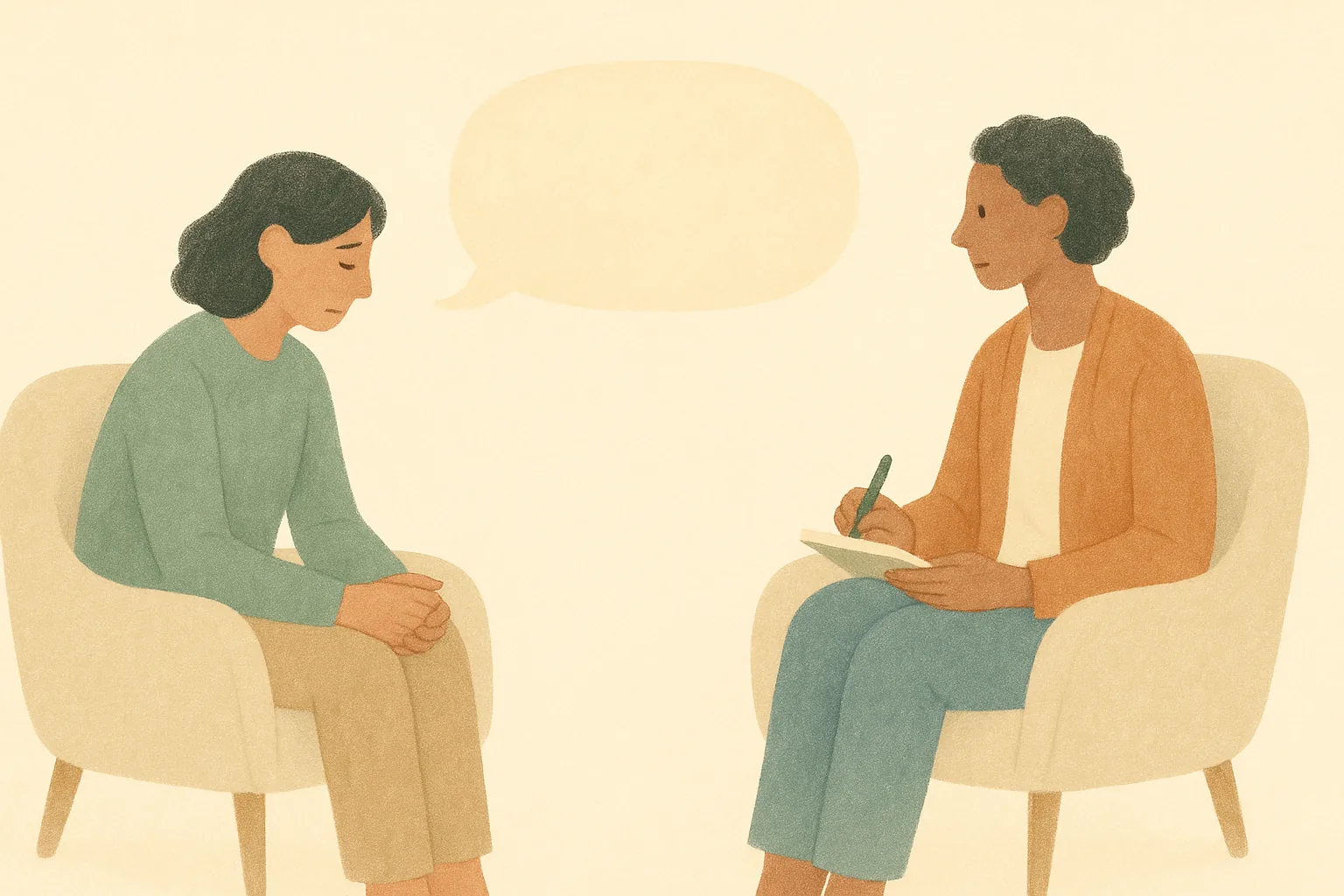
What should I talk about in therapy if I'm not sure?
Talk about whatever is on your mind that day, even if it feels small or unrelated. There's no wrong topic and no required starting point. The simple act of showing up and speaking honestly is the work beginning.
Most people arrive with a vague sense that something's off rather than a tidy agenda. You might feel anxious, tired, irritable, or just not like yourself. You don't have to name it perfectly. You only have to start talking, and the shape of it becomes clearer from there.
Think of the first thing you say as a door, not a summary. A rough week, a conversation that stuck with you, a worry that keeps circling back at night. Any of these opens the room. My job is to listen and ask the next question, so you're never carrying the whole thing alone.
Why not knowing is completely normal
Not knowing what to say is one of the most common feelings people bring to a first session, and it isn't a sign you're doing it wrong. Per the American Psychological Association, starting psychotherapy can feel uncertain at first, and finding a comfortable rhythm with a therapist takes a little time. Expect the first sessions to feel like getting your footing, not delivering a report.
We're not taught how to talk about our inner lives. Many of us grew up in families or cultures where you handled things quietly and kept struggle private. If that's you, walking in unsure isn't a personal failing. It's the natural result of never having had the space to practice.
I speak Hindi, Urdu, and Punjabi, and I work with a lot of clients from immigrant and multicultural backgrounds. A common worry I hear is whether their problems are "big enough" to deserve help. They almost always are. You don't have to earn your seat with a crisis.
Simple ways to start when your mind goes blank
When you sit down and your mind empties out, you don't have to force a topic. A few honest openers do the job, and any of these is enough to get a session moving.
- "I honestly don't know where to start today."
- "This week felt heavier than usual, and I'm not sure why."
- "Something's been on my mind, but it feels too small to mention."
- "I've been more irritable lately and it's affecting people I care about."
- "I want to feel less anxious, but I can't point to one cause."
- "Can we just talk about how the last few days have gone?"
Notice that none of these require a diagnosis or a polished story. They point at a feeling or a stretch of time, and that's plenty. A good therapist takes it from there and helps you follow the thread.
What a first therapy session is actually like
A first session is mostly a conversation to get to know each other, not a deep excavation of your worst moments. I usually ask what brought you in, a little about your life and history, and what you're hoping might be different. You lead the pace, and you share only what feels okay to share that day.
Part of the first session is practical. We talk about how sessions work, confidentiality and its limits, and whether the fit between us feels right. Fit matters more than most people expect, and it's genuinely fine to notice you'd prefer someone else.
You will not be pushed to relive something you're not ready for. If a question feels like too much, you can say "I'd rather not get into that yet," and we move on. Trust is built over time, and there's no test to pass on day one.
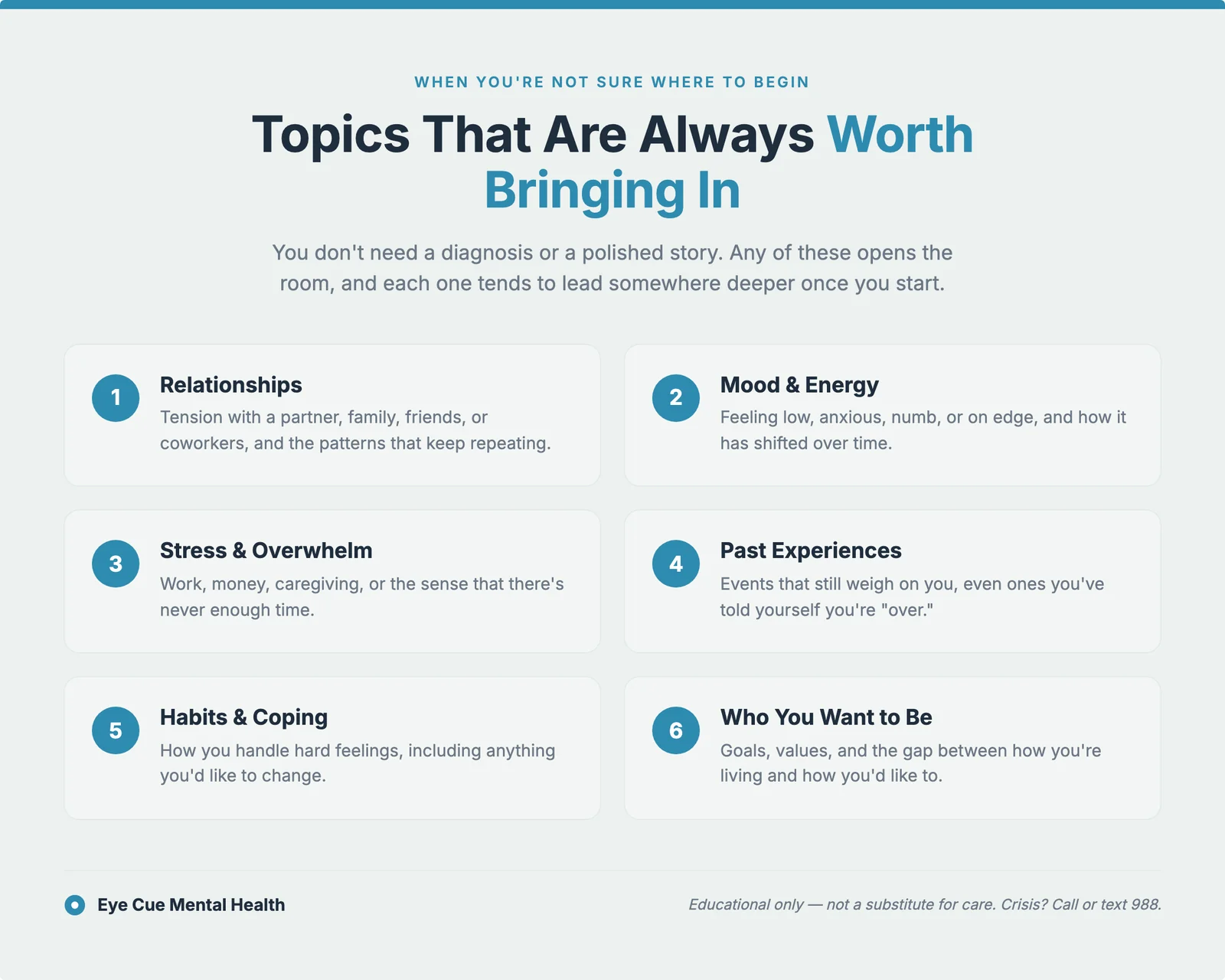
Topics that are always worth bringing in
If you want a starting list, these are the areas people find most useful to explore, and each one tends to open into something deeper once you begin talking about it.
- Relationships: tension with a partner, family, friends, or coworkers, and the patterns that keep repeating.
- Mood and energy: feeling low, anxious, numb, or on edge, and how it's shifted over time.
- Stress and overwhelm: work, money, caregiving, or the sense that there's never enough time.
- Past experiences: events that still weigh on you, even ones you've told yourself you're "over."
- Habits and coping: how you handle hard feelings, including anything you'd like to change.
- Who you want to be: goals, values, and the gap between how you're living and how you'd like to.
There's real overlap between these and the reasons people seek out specific support. If persistent worry is the loudest thread, our anxiety therapy approach is built around exactly that, and low mood that won't lift is the focus of depression therapy. You don't have to sort yourself into a category first, though. We figure that out together.
What if I get emotional, or nothing comes out at all?
Getting emotional or going quiet are both normal parts of therapy, not signs it's going badly. Silence often means you've reached something that matters, and tears are frequently a release rather than a breakdown. Let the moment be what it is.
If you tear up, that's welcome, and I'm not going to rush you past it. Some of the most useful sessions I've been part of started with someone apologizing for crying two minutes in. There's nothing to apologize for.
If you go blank, say so. "My mind just emptied out" is useful information, and we can sit with the quiet or gently explore what showed up right before it. Learning to notice these moments is part of what therapy teaches, and it gets easier with practice.
How access works at Eye Cue Mental Health
Cost and logistics stop a lot of people before they ever start, so I want to be plain about how it works here. Eye Cue Mental Health accepts Medi-Cal and several private plans, and we offer telehealth across California alongside in-person sessions in Cerritos. Whether your specific plan covers a given service depends on your plan, and we verify that before you begin.
We serve Los Angeles County, Orange County, and clients statewide by video, with a team of clinicians who speak a range of languages. If you're deciding between formats, video sessions are just as substantive as in-person ones for most people, and they remove the drive.
Starting doesn't commit you to anything long-term. A first conversation is exactly that, a conversation, and you get to decide what happens next.
The questions I hear most from people who aren't sure what to say, answered plainly.
Ready when you are, even if you don't have the words yet
You don't need a script, a diagnosis, or a reason that sounds serious enough. If something's felt off and you're curious whether talking would help, that's reason enough to reach out. A course of individual therapy at Eye Cue Mental Health gives you a private, unhurried space to find your words, in person in Cerritos or by video across California, and we accept Medi-Cal and many private plans. Call 562-860-2891 whenever you're ready.
This article was written and reviewed by Saqib Iqbal, LCSW, founder of Eye Cue Mental Health in Cerritos, California. He has practiced psychotherapy since opening the practice in 2017, supervises the clinical team, and reviews the practice's mental health guides for accuracy.
Frequently asked questions
What if I don't know what to talk about in therapy?
That's completely normal, and it's not a problem. You can start a session by simply saying you're not sure where to begin. A good therapist expects that and will ask gentle questions to help you find a starting point. You don't need a polished topic or a crisis to make the time worthwhile.
What do you talk about in your first therapy session?
A first session is usually more of a conversation than a deep dive. Your therapist asks what brought you in, a bit about your background, and what you're hoping to feel or change. Much of it is you both getting a sense of whether the fit feels right. You share only what you're comfortable sharing.
Is it okay to talk about small or everyday things in therapy?
Yes. The 'small' things, a hard week at work, a tense text, feeling tired for no clear reason, often open the door to what matters most. Therapy isn't reserved for major trauma. Everyday stress, relationships, and mood are all worth bringing in.
What if I get emotional or go blank during a session?
Both are welcome and common. Getting emotional is often a sign you've reached something important, and your therapist is trained to stay with you through it. If you go blank, you can say so out loud. Silence and sitting with a feeling are part of the work, not a failure.
Do I have to have a diagnosis to start therapy?
No. You don't need a diagnosis, a specific problem, or a reason that sounds serious enough. Feeling stuck, overwhelmed, or just wanting to understand yourself better are all valid reasons to start. If you'd like to talk it through, call us at 562-860-2891.
One-on-one talk therapy in Cerritos and by telehealth across California, covered by Medi-Cal.
Learn moreEye Cue Mental Health is a psychotherapy practice and does not prescribe medication. This article is educational and is not a diagnosis or a substitute for professional care. If you are in crisis, call or text 988 (Suicide and Crisis Lifeline) any time.
