


Adjustment disorder is a strong emotional or behavioral reaction to a major life change or stressor, one that feels bigger than the situation seems to call for. It is common, it is treatable, and for most people it eases within a few months. If a recent change has left you feeling stuck, adjustment disorder therapy at Eye Cue Mental Health can help you find your footing again, in person in Cerritos or by video across California.
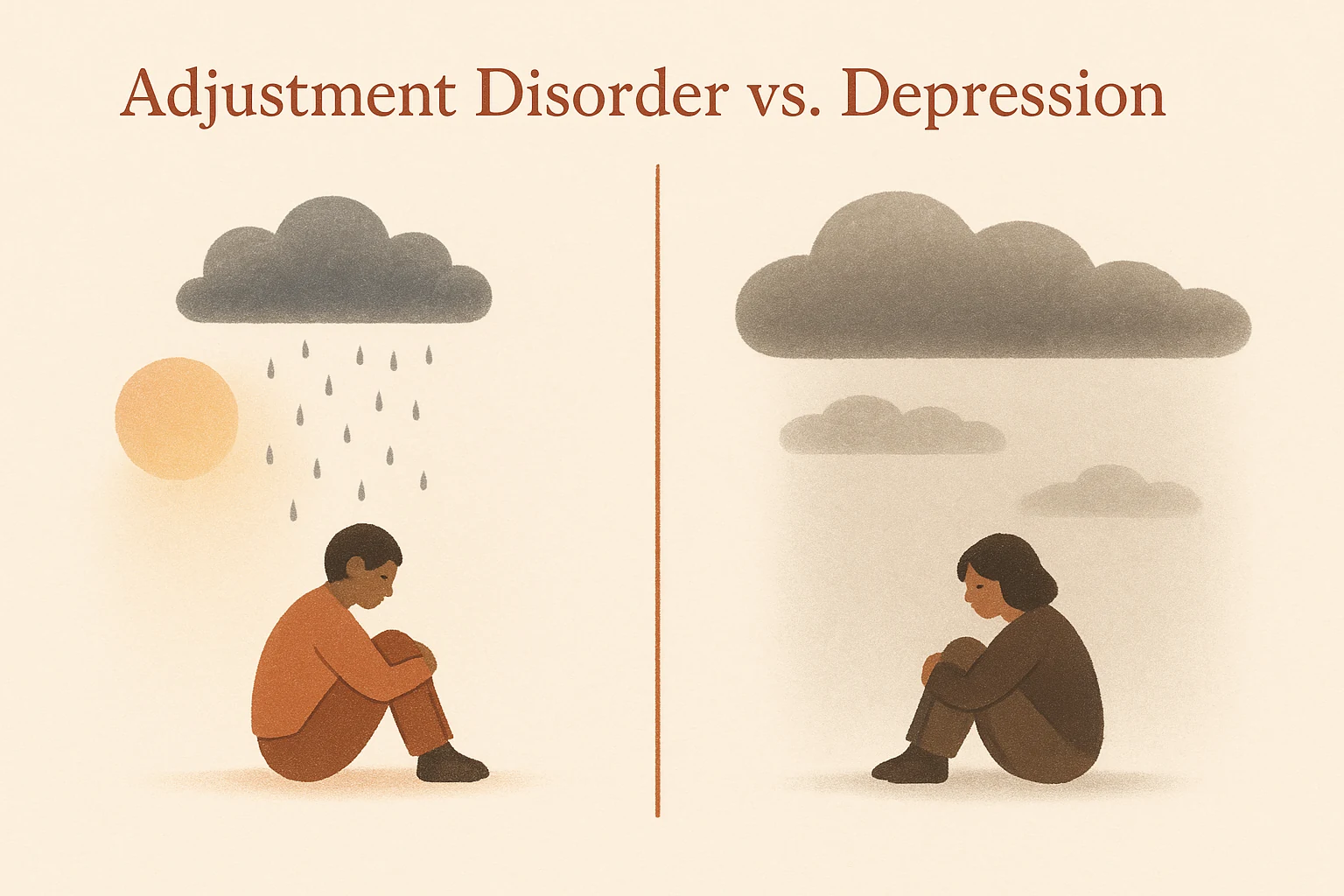
What is adjustment disorder, exactly?
Adjustment disorder is a diagnosable stress-response condition: an out-of-proportion reaction to an identifiable stressor that gets in the way of daily life. Per the American Psychiatric Association's DSM-5, the emotional or behavioral symptoms begin within three months of the stressor and cause distress that is greater than expected, or that meaningfully disrupts work, school, or relationships.
The trigger can be almost anything that shifts the ground under you: a move, a divorce or breakup, a job loss, a new diagnosis, a death in the family, retirement, or even a positive change like a new baby or a promotion. What makes it a disorder is not the event itself, but how much the reaction is interfering with your ability to function.
Clinicians sometimes describe subtypes based on the main feeling involved: adjustment disorder with depressed mood, with anxiety, with mixed anxiety and depressed mood, or with disturbance of conduct. You do not need to know your subtype to get help. It is simply how a clinician maps what you are experiencing.
What are the signs and symptoms of adjustment disorder?
The signs of adjustment disorder cluster around feeling overwhelmed by a change you cannot seem to move past. According to the Cleveland Clinic, symptoms are emotional, behavioral, or both, and they show up soon after the stressor. Watch for a pattern rather than a single bad day.
- Persistent sadness, tearfulness, or a sense of hopelessness
- Worry, nervousness, or feeling unable to cope
- Trouble sleeping or concentrating
- Loss of interest in things you used to enjoy
- Feeling overwhelmed or unable to plan ahead
- Withdrawing from friends, family, or work
- In teens, acting out or a drop in school performance
These overlap with other conditions, which is why the timing and the trigger matter so much. If several of these have shown up since a specific change, and they are not easing, it is worth talking to someone. Our individual therapy team works with exactly this kind of stress-and-change distress every day.
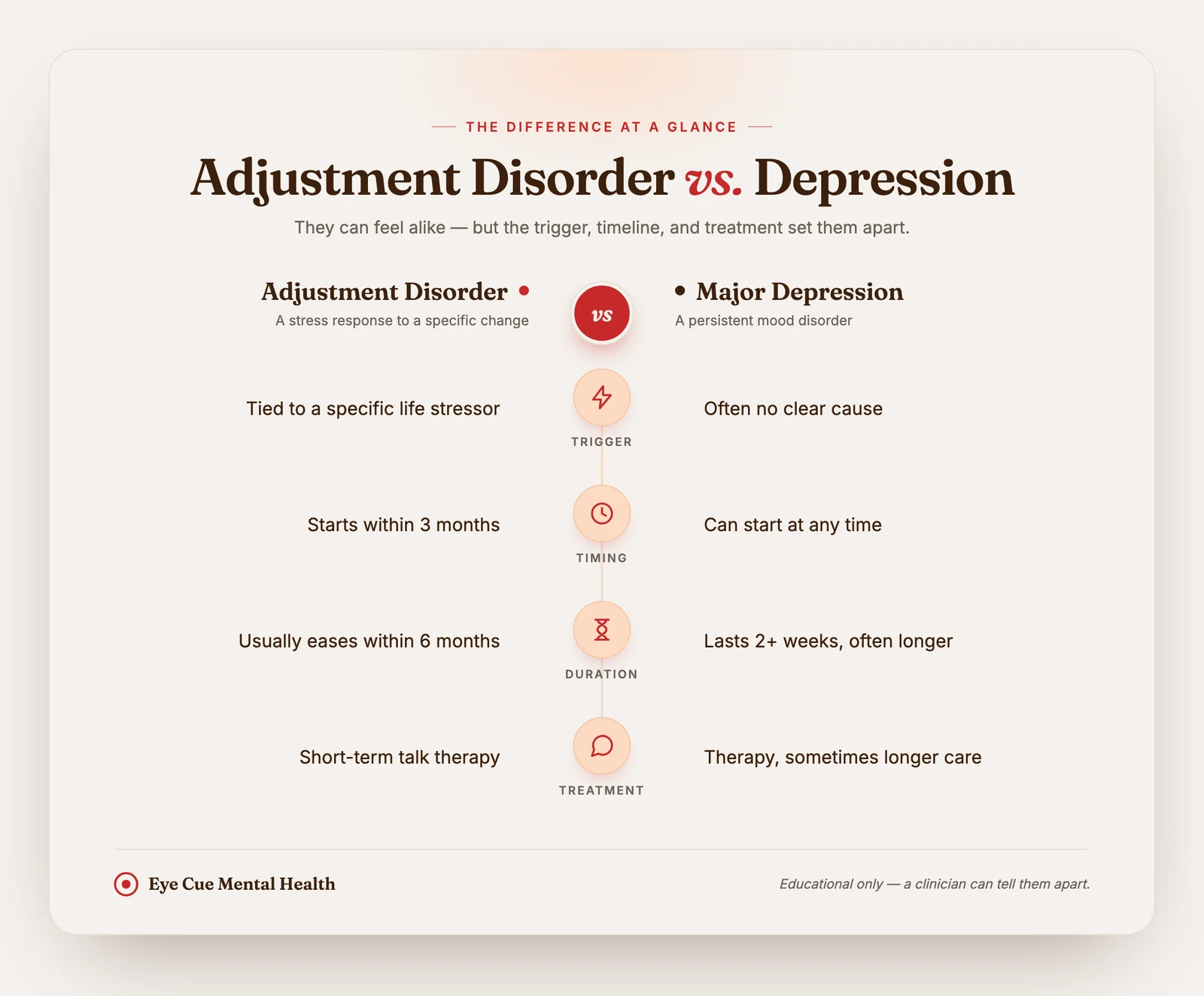
How is adjustment disorder different from depression?
The clearest difference is the trigger and the timeline. Adjustment disorder is tied to a specific, identifiable stressor and typically resolves within six months once you adapt or the stressor ends; major depression can arise without an obvious cause and tends to last longer and reach deeper. The National Institute of Mental Health notes that major depression involves a persistent set of symptoms most of the day, nearly every day, for at least two weeks, often independent of any single event.
That distinction is not academic. It changes the plan. Someone processing a hard but time-limited change may need focused, short-term support to build coping skills, while someone with major depression may need a longer course of care. A clinician sorts this out in an assessment, and the same visit can also rule out an anxiety disorder or post-traumatic stress. If your symptoms look more like ongoing low mood, our depression therapy page explains that path; if worry is the loudest part, anxiety therapy may fit better.
What causes adjustment disorder?
Adjustment disorder is caused by a stressor that outpaces your current coping resources, not by a personal flaw. The same event can barely register for one person and knock another off balance, depending on timing, support, past experiences, and how many stressors are stacking up at once.
Common triggers include:
- Relationship changes. Divorce, a breakup, conflict at home, or becoming a caregiver.
- Work and money. Job loss, a difficult new role, or financial strain.
- Health. A new diagnosis, a surgery, or a change in a loved one's health.
- Loss and transition. A death, a move, retirement, or children leaving home.
Sometimes it is one large event. Just as often it is several smaller ones arriving together, until the load is more than your usual routines can carry.
How long does adjustment disorder last?
For most people, adjustment disorder is time-limited. Symptoms start within three months of the stressor and, per the DSM-5 framework, do not continue more than six months after the stressor or its consequences have resolved. Many people feel meaningfully better well before that, especially with support.
If distress drags on past six months, or keeps getting worse, that is a signal for a clinician to re-evaluate. It may mean the situation is ongoing, or that what looked like adjustment disorder is closer to major depression or an anxiety disorder. Either way, that is useful information, not a setback.
How is adjustment disorder treated?
Adjustment disorder is treated first with psychotherapy, which is short-term talk therapy that helps you process the change and rebuild coping skills. Per the American Psychological Association, approaches like cognitive behavioral therapy help you recognize the thoughts driving the distress and respond to them differently, while supportive therapy gives you a steady place to work through the transition.
At Eye Cue Mental Health, care for adjustment disorder usually looks like a focused course of individual therapy built around your specific stressor. Because we accept Medi-Cal and several private plans, and offer telehealth across California as well as in-person sessions in Cerritos, it is easier to start before the distress compounds. Medication is sometimes considered for sleep or anxiety; as a psychotherapy practice we do not prescribe, but we help coordinate with a prescriber when it makes sense.
The questions we hear most about adjustment disorder, answered in plain language.
Ready to work through a hard change? Start adjustment disorder therapy
You do not have to white-knuckle your way through a major life change. If a recent event has left you overwhelmed, adjustment disorder therapy at Eye Cue Mental Health gives you a focused, private space to process it and get back to yourself. We see clients in person in Cerritos and by video across California, and we accept Medi-Cal and many private plans. Call 562-860-2891 to talk it through.
This article was reviewed by Saqib Iqbal, LCSW, founder of Eye Cue Mental Health in Cerritos, California. He supervises the clinical team and reviews the practice's mental health guides for accuracy.
Frequently asked questions
Is adjustment disorder a real mental health diagnosis?
Yes. Adjustment disorder is a recognized diagnosis in the DSM-5, the manual clinicians use to identify mental health conditions. It describes an out-of-proportion emotional or behavioral reaction to an identifiable life stressor. It is common and treatable, and it is not a sign of weakness.
Is adjustment disorder the same as depression?
No. Adjustment disorder is tied to a specific stressor and usually eases within six months once you adapt or the stressor resolves. Major depression can occur without a clear trigger, tends to last longer, and involves a broader set of symptoms. A clinician can tell them apart during an assessment, which matters because the treatment plans differ.
How long does adjustment disorder last?
By definition, symptoms begin within three months of the stressor and do not persist more than six months after the stressor or its consequences have ended. If distress lasts longer than that, a clinician will re-evaluate for another condition such as major depression or an anxiety disorder.
Do I need medication for adjustment disorder?
Usually not. Psychotherapy, especially short-term talk therapy and cognitive behavioral therapy, is the first-line approach for adjustment disorder. Eye Cue Mental Health is a psychotherapy practice and does not prescribe medication; if medication is worth considering, we help coordinate that with a prescriber.
When should I see a therapist about adjustment disorder?
Consider reaching out if the distress is interfering with work, school, sleep, or relationships, or if it has lasted more than a couple of weeks and is not easing. You do not have to wait until things feel unbearable. Call us at 562-860-2891 to talk it through.
Adjustment disorder therapy in Cerritos and by telehealth across California, covered by Medi-Cal.
Learn moreEye Cue Mental Health is a psychotherapy practice and does not prescribe medication. If you are in crisis, call or text 988 (Suicide and Crisis Lifeline) any time.
