


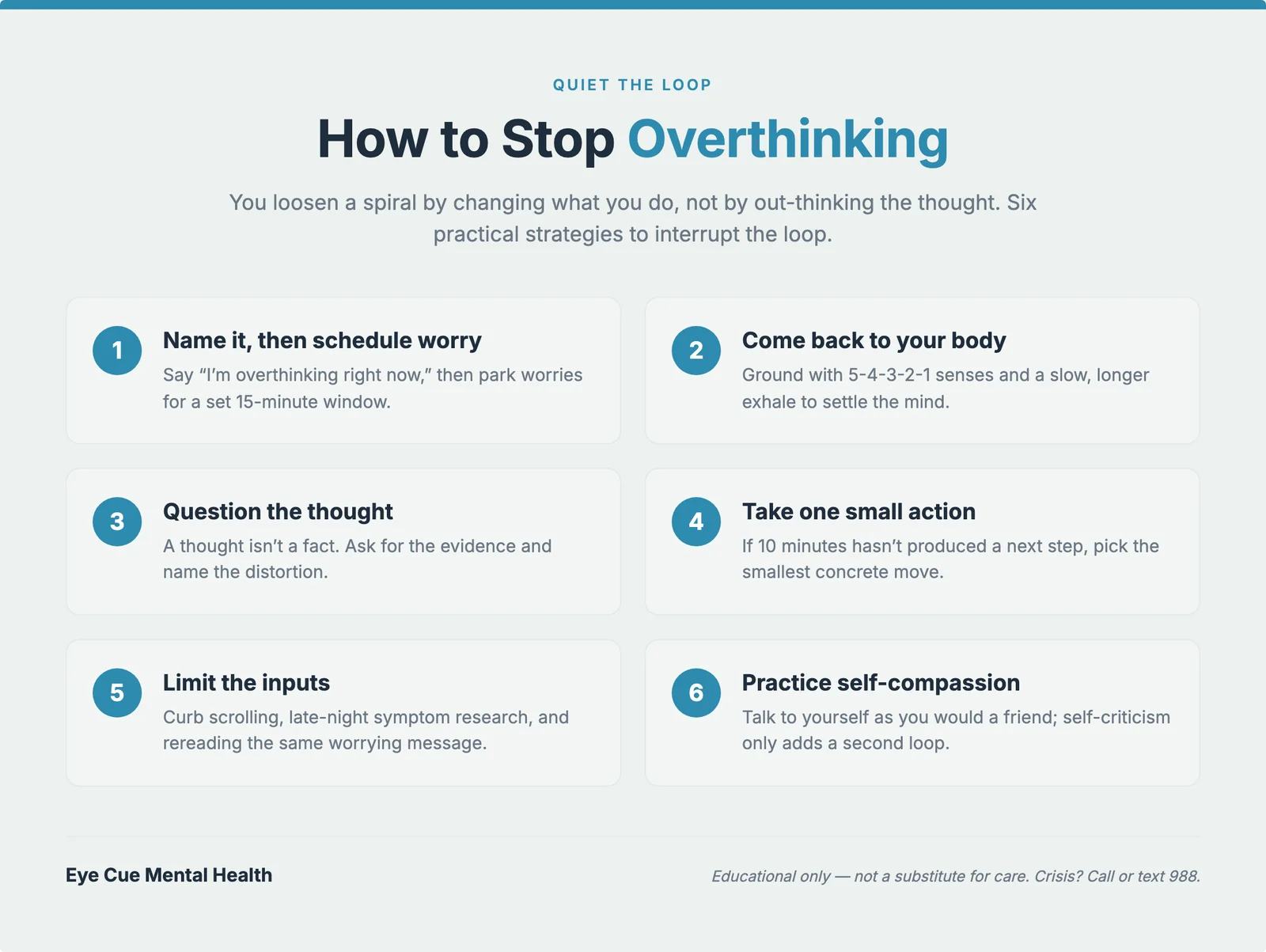
I'm Saqib Iqbal, a licensed clinical social worker and the founder of Eye Cue Mental Health in Cerritos. The question I hear most often, from clients across Los Angeles and Orange County, is some version of "how do I get my brain to stop." If overthinking is running your nights and crowding your days, anxiety therapy at Eye Cue Mental Health can help, and there are things you can start on your own today. Here are six that hold up.

How do you stop overthinking?
You stop overthinking by interrupting the loop, not by trying harder to "think your way out" of it. Per the American Psychological Association, rumination tends to deepen distress rather than resolve it, which is why more thinking rarely helps. Use the strategies below to shift your attention, your body, or your patterns instead of arguing with the thought.
First, it helps to understand why the mind loops at all. Overthinking usually feels like problem-solving. Replaying a conversation or rehearsing a worst case gives a brief sense of control, and that small relief trains your brain to do it again. The loop is the habit, not the topic.
That is good news. A habit can be interrupted. None of what follows requires you to win an argument with your own thoughts, which is a fight that tends to keep them louder. The point is to change what you do, so the loop has somewhere else to go.
1. Name it, then schedule your worry
The fastest way to loosen a spiral is to notice you're in one. Say to yourself, plainly, "I'm overthinking right now." That small step creates a gap between you and the thought, which is the whole game.
Then try what clinicians call scheduled worry time. You set aside 15 minutes later in the day, and when a worry shows up outside that window, you jot it down and tell yourself you'll get to it then. Research on this technique, sometimes called stimulus control for worry, suggests that containing rumination to a set time can reduce how much it intrudes the rest of the day.
Most people find that by the time their worry window arrives, half the items no longer feel urgent. You're not suppressing the thought. You're deciding when to give it your attention.
2. Come back to your body with grounding
When your mind is racing, your attention has left the present and jumped into the past or the future. Grounding techniques pull it back by anchoring you in what your senses can actually detect right now.
The one I teach most is called 5-4-3-2-1. Name five things you can see, four you can hear, three you can touch, two you can smell, and one you can taste. It sounds almost too simple, but it works because the mind can't fully ruminate and pay close attention to the room at the same time.
Slow breathing helps for the same reason. Try breathing out for longer than you breathe in, for a minute or two. A longer exhale nudges your nervous system toward calm, which makes it easier to step out of the loop.
3. Question the thought instead of believing it
A core skill in cognitive behavioral therapy is learning that a thought is not a fact. Per the National Institute of Mental Health, CBT helps people recognize and reframe the thinking patterns that fuel anxiety, and questioning a worry is one of the most useful tools inside it.
When a looping thought grabs you, ask a few plain questions. What's the actual evidence for this? Have I confused a possibility with a certainty? If a friend said this to me, what would I tell them?
The goal isn't forced positivity. It's accuracy. Most overthinking runs on distortions like catastrophizing ("this will ruin everything") or mind-reading ("she must be angry"). Naming the distortion often shrinks it back to size.
4. Take one small action
Overthinking thrives on indecision, and indecision feeds more overthinking. The way out is usually a small, concrete action, not a perfect one.
Here's a test I give clients. If 10 minutes of thinking hasn't produced a next step, you're ruminating, not solving. So pick the smallest possible move: send the one email, make the list, ask the clarifying question, or set a five-minute timer and just start.
Action collects real information, which is something thinking can't do. It replaces the imagined worst case with what actually happens, and that almost always loosens the grip of the loop.
5. Limit the inputs that feed the loop
Some overthinking is fed from the outside. Endless scrolling, late-night research on your symptoms, or reading the same worrying message over and over gives the loop fresh fuel and a sense of urgency it doesn't deserve.
Small limits make a real difference. Try a screen cutoff an hour before bed, since a tired brain ruminates more easily. Notice when you're "researching" a worry past the point of usefulness, and give yourself permission to stop. Move your phone across the room so checking it takes effort.
You don't have to overhaul your life. Removing one or two of the biggest triggers is often enough to quiet the noise the rest of these strategies are working against.
6. Practice self-compassion
This is the one people skip, and it may matter most. When you catch yourself overthinking and then criticize yourself for overthinking, you've simply added a second loop on top of the first.
Self-compassion means talking to yourself the way you'd talk to someone you care about. Overthinking is not a character flaw. It's usually an anxious brain trying, clumsily, to keep you safe. Meeting that with "of course I'm worried, this matters to me" is far more effective than "what's wrong with me."
Research from psychologist Kristin Neff on self-compassion links a kinder inner stance to lower anxiety and rumination. Warmth toward yourself isn't a reward for stopping the loop. It's part of how the loop lets go.
When overthinking is worth talking to a therapist
Sometimes overthinking is a passing rough patch, and these strategies are enough. Other times it's a signal worth paying attention to. In general, it's worth reaching out to a licensed clinician when the looping is most days, feels impossible to switch off, and is costing you sleep, focus, or connection with the people you love.
Persistent rumination and worry are common features of anxiety and depression, and you don't need a diagnosis before you're allowed to ask for help. A therapist can look at the fuller picture instead of one symptom, and CBT in particular has strong support for the patterns underneath overthinking. For teens caught in the same spirals, our teen therapy is built for that stage of life, and if low mood is riding alongside the worry, depression therapy may be the better starting point.
If you ever feel unsafe or have thoughts of harming yourself, please reach out right away. You can call or text 988, the Suicide and Crisis Lifeline, any time, day or night.
The questions I hear most about how to stop overthinking, answered in plain language.
Ready to quiet the loop? Start anxiety therapy
You don't have to keep negotiating with a racing mind on your own. If overthinking is taking up your nights and your energy, anxiety therapy at Eye Cue Mental Health gives you a private, structured space to understand the loop and build habits that interrupt it. We see clients in person in Cerritos and by video across California, and we accept Medi-Cal and many private plans. Call 562-860-2891 to talk it through.
This article was reviewed by Saqib Iqbal, LCSW, founder of Eye Cue Mental Health in Cerritos, California. He supervises the clinical team and reviews the practice's mental health guides for accuracy.
Frequently asked questions
Why can't I stop overthinking?
Overthinking sticks around because it feels productive without being productive. Your brain treats worry as problem-solving, so replaying a situation gives a false sense of control. That short-lived relief teaches the mind to loop again next time. For many people, it also runs alongside anxiety, which keeps the alarm system switched on and the thoughts spinning.
Is overthinking a sign of anxiety?
It can be. Overthinking is not a diagnosis on its own, but persistent rumination and worry are common features of anxiety disorders and depression. If the looping is constant, hard to switch off, and getting in the way of sleep, work, or relationships, it is worth talking with a licensed clinician who can look at the fuller picture rather than one symptom.
What is the difference between overthinking and problem-solving?
Problem-solving moves toward a decision or action, then stops. Overthinking circles the same ground without landing anywhere, and usually leaves you more anxious than when you started. A simple test: if 10 minutes of thinking has not produced a next step, you are likely ruminating, not solving, and it is time to change what you are doing.
Can therapy help with overthinking?
Yes. Cognitive behavioral therapy, or CBT, is well-supported for the rumination and worry that drive overthinking. It helps you notice thought patterns, question them, and build habits that interrupt the loop. At Eye Cue Mental Health we offer this kind of talk therapy in Cerritos and by telehealth across California, and we accept Medi-Cal and many private plans.
When should I see a therapist about overthinking?
Consider reaching out if the looping is most days, hard to control, and costing you sleep, focus, or connection with people you care about. You do not need a diagnosis first, and you do not have to wait until it feels unbearable. Call us at 562-860-2891 to talk it through. If you ever feel unsafe, call or text 988 any time.
Anxiety therapy in Cerritos and by telehealth across California, covered by Medi-Cal and many private plans.
Learn moreEye Cue Mental Health is a psychotherapy practice and does not prescribe medication. This article is educational and is not a diagnosis or a substitute for professional care. If you are in crisis, call or text 988 (Suicide and Crisis Lifeline) any time.
