


Trust is the quiet floor a relationship stands on, and when it cracks, everything above it feels unsteady. I'm Saqib Iqbal, an LCSW and the founder of Eye Cue Mental Health in Cerritos, California, and rebuilding trust is one of the most common things couples bring into my office. If you and your partner are stuck here, couples counseling with our team can give you a structured way through it. This guide walks the practical steps, and it's educational, not a diagnosis.

How do you rebuild trust in a relationship?
You rebuild trust in a relationship by taking full responsibility for the breach, staying consistently honest over time, and letting your actions slowly prove your words. There's no shortcut and no single apology that resets it. The Gottman Institute, which has studied couples for decades, describes trust as something built through many small moments of showing up, not one dramatic fix.
That reframe helps because it takes the pressure off the perfect speech. What earns trust back is the ordinary follow-through: doing what you said you'd do, again and again, even when nobody's watching.
Below I've broken the work into steps. They apply whether the breach was a lie, an affair, a broken promise, or a slow erosion of feeling unseen.
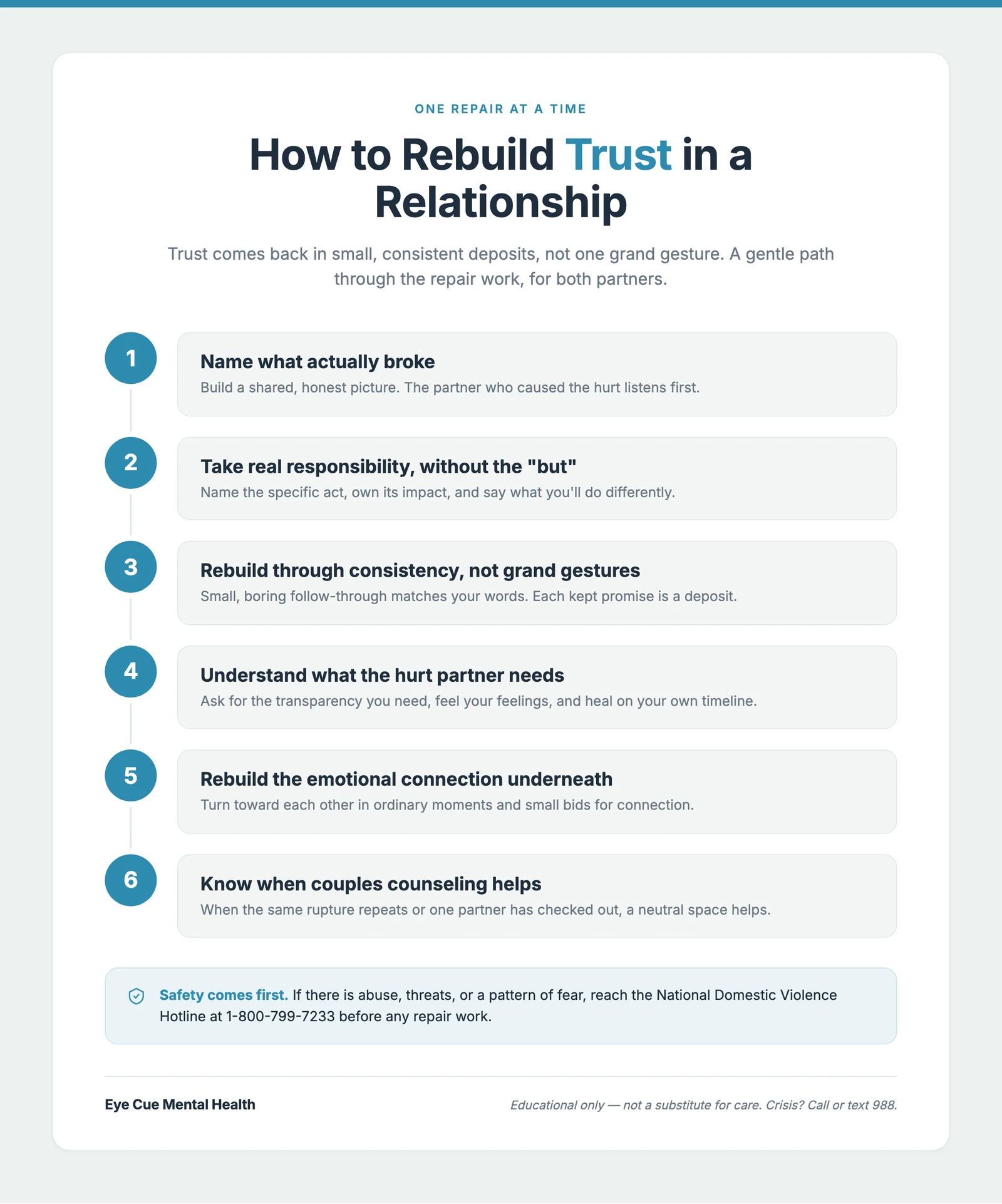
Start by naming what actually broke
Before any repair, both of you need a shared, honest picture of what happened. Vague apologies for "everything" don't land, because the hurt partner needs to hear that you understand the specific thing that wounded them.
That means the partner who caused the hurt does most of the listening first. Not defending, not explaining the reasons yet, just hearing how it felt from the other side. It's uncomfortable, and it's where a lot of couples get stuck on their own.
If you can't get through this conversation without it spiraling into blame, that's a sign a neutral third party could help. It's also the moment when many people first look into couples counseling with a trained clinician.
Take real responsibility, without the "but"
A repair attempt only works when it's clean. "I'm sorry you felt that way" is not an apology; it hands the problem back to the person who was hurt. Owning it sounds different.
Real responsibility has a few parts:
- Name the specific thing you did, in plain words.
- Acknowledge the impact it had on your partner, not just your intent.
- Skip the "but" that follows most apologies and quietly cancels them out.
- Say what you'll do differently, and keep it small enough that you can actually deliver.
The research on relationship repair, including work summarized by the American Psychological Association, points to accountability and responsiveness as core to how couples recover. A defensive apology reads as another small betrayal.
Rebuild through consistency, not grand gestures
Here's the part that surprises people. The hurt partner isn't usually looking for flowers or a dramatic promise. They're watching for whether the small, boring things now match your words.
Trust comes back in tiny deposits. You said you'd be home by six, and you were. You shared your phone without being asked. You brought up the hard topic yourself instead of waiting to be caught. Each one is a data point, and the hurt partner is quietly counting them.
This is also why rushing backfires. If you've broken trust and you're frustrated that your partner "still doesn't trust me," remember they're not being difficult. They're recalibrating based on evidence, and evidence takes time to accumulate.
Understand what the hurt partner needs
If you're the one who was hurt, this stage is exhausting in its own way. The instinct swings between wanting reassurance and wanting to protect yourself from getting hurt again. Both are normal.
A few things tend to help the hurt partner move forward:
- Ask for specific transparency you actually need, rather than testing in secret.
- Let yourself feel the anger and grief instead of pretending you're fine to keep the peace.
- Notice the deposits when they happen, even while you stay cautious.
- Give yourself permission to heal on your own timeline, not your partner's.
You're allowed to still feel shaky even when your partner is doing everything right. Healing and forgiveness aren't the same thing, and neither happens on command.
Rebuild the emotional connection underneath
Once the acute crisis settles, most couples still have to rebuild the closeness that eroded. Trust and connection feed each other, and a breach usually damages both.
This looks like turning toward each other in ordinary moments: the small bids for attention, the check-in texts, the shared jokes that went quiet. Gottman's research calls these bids for connection, and how partners respond to them predicts a lot about where a relationship heads.
Rebuilding intimacy after a betrayal can bring up its own grief, and sometimes older wounds surface too. When that happens, individual work alongside the couples work can help. Our individual therapy is often a good companion to the joint sessions, especially when one partner is carrying trauma from before the relationship.
When couples counseling helps, and when it's essential
Couples counseling helps most when both partners want to repair but keep hitting the same wall on their own. A trained clinician gives you a structured, neutral space so the harder conversations don't collapse into the fight you've had a hundred times.
I'd suggest reaching out when the same rupture keeps repeating, when one of you has emotionally checked out, or after a betrayal you can't seem to move past no matter how hard you try. You don't have to wait until you're at the edge of a breakup.
There's one situation where "counseling" isn't the first step. If there's physical abuse, threats, or a pattern of fear and control, safety comes before repair, and traditional couples therapy can even be unsafe. If that's your situation, please reach the National Domestic Violence Hotline at 1-800-799-7233. At Eye Cue Mental Health, when couples work is a fit, we offer it in person in Cerritos and by telehealth across California, and we accept Medi-Cal and many private plans so cost is less of a barrier to starting.
The questions couples ask me most often about rebuilding trust, answered plainly.
Ready to rebuild? Start couples counseling
You don't have to figure out how to rebuild trust in a relationship on your own. If the same hurt keeps circling back, couples counseling at Eye Cue Mental Health gives you a private, structured space to do the repair work with support. We see couples in person in Cerritos and by video across California, and we accept Medi-Cal and many private plans. Call 562-860-2891 to talk it through.
This article was reviewed by Saqib Iqbal, LCSW, founder of Eye Cue Mental Health in Cerritos, California. He supervises the clinical team and works with couples across Los Angeles and Orange County, in English and in Hindi, Urdu, and Punjabi.
Frequently asked questions
Can trust be rebuilt after it's broken?
Yes, for many couples trust can be rebuilt, though it takes consistent honesty over time, not a single apology. Research by the Gottman Institute frames trust as something partners build through many small moments of reliability, not one grand gesture. The partner who broke the trust has to stay transparent and patient while the hurt partner slowly re-tests whether it's safe to count on them again. It rarely moves in a straight line.
How long does it take to rebuild trust in a relationship?
There's no fixed timeline, and in general it takes months rather than days, sometimes longer after a major betrayal like an affair. The pace depends on the size of the breach, whether it's still happening, and how consistently the repair work continues. Trying to rush a hurt partner back to 'normal' usually backfires. Steady, repeated follow-through is what shortens the road, not pressure.
Should we stay together while trying to rebuild trust?
That's a personal decision, and there's no single right answer. Many couples do the repair work while living together; others need space first. What matters more than the living arrangement is whether both people genuinely want to rebuild and are willing to be honest. If there's ongoing abuse, control, or fear, safety comes before any repair work, and reaching out for help is the priority.
What if my partner won't take responsibility?
Rebuilding trust needs both people, and it stalls when the partner who caused the hurt won't own it. You can't repair a breach on your own by trying harder to forgive. In general, if one partner keeps minimizing, blaming, or hiding, a neutral third party like a couples therapist can help surface what's really going on, or help you get clarity on whether the relationship can meet your needs.
When should we see a couples counselor about trust?
Consider reaching out when the same argument keeps repeating, when one of you has withdrawn, or after a betrayal you can't seem to move past on your own. You don't need to be on the brink of a breakup to benefit. Call us at 562-860-2891 to talk it through, in person in Cerritos or by video anywhere in California.
Couples counseling in Cerritos and by telehealth across California, covered by Medi-Cal.
Learn moreEye Cue Mental Health is a psychotherapy practice and does not prescribe medication. This article is educational and is not a diagnosis or a substitute for professional care. If you feel unsafe with a partner, contact the National Domestic Violence Hotline at 1-800-799-7233. If you are in crisis, call or text 988 (Suicide and Crisis Lifeline) any time.
