


I'm Saqib Iqbal, LCSW. I opened Eye Cue Mental Health in Cerritos in 2017 to make real therapy reachable for people who had been priced out of it, and the question I hear before almost any other is some version of "how much does therapy cost?" So let me answer it honestly. There is no single price, but there is a right path for your situation, and therapy covered by Medi-Cal means low or no cost for a lot of the people I meet.
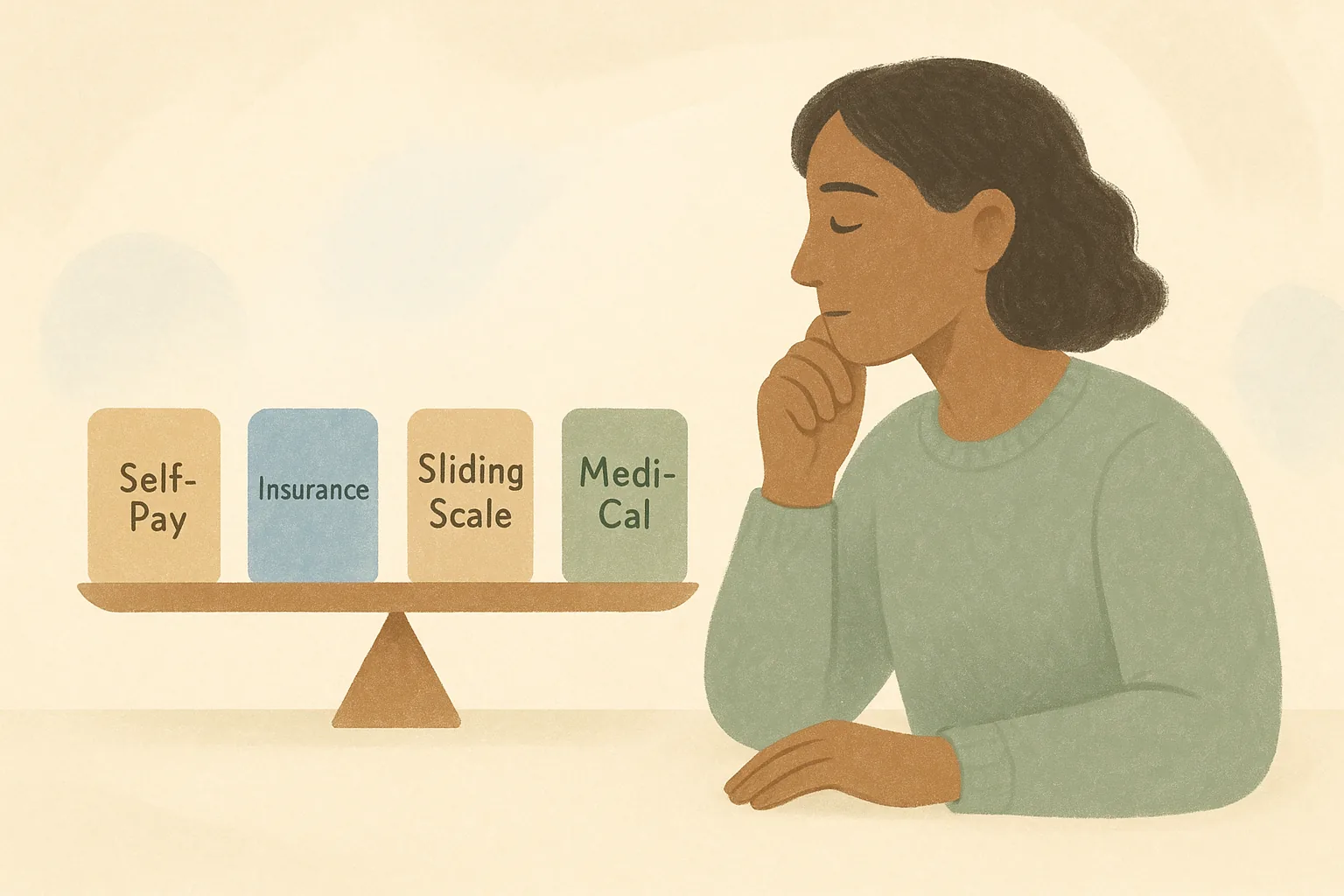
How much does therapy cost per session?
Therapy costs anywhere from little or nothing to a few hundred dollars a session, depending on how you pay. The number that matters is not the sticker price. It is the price on your specific path.
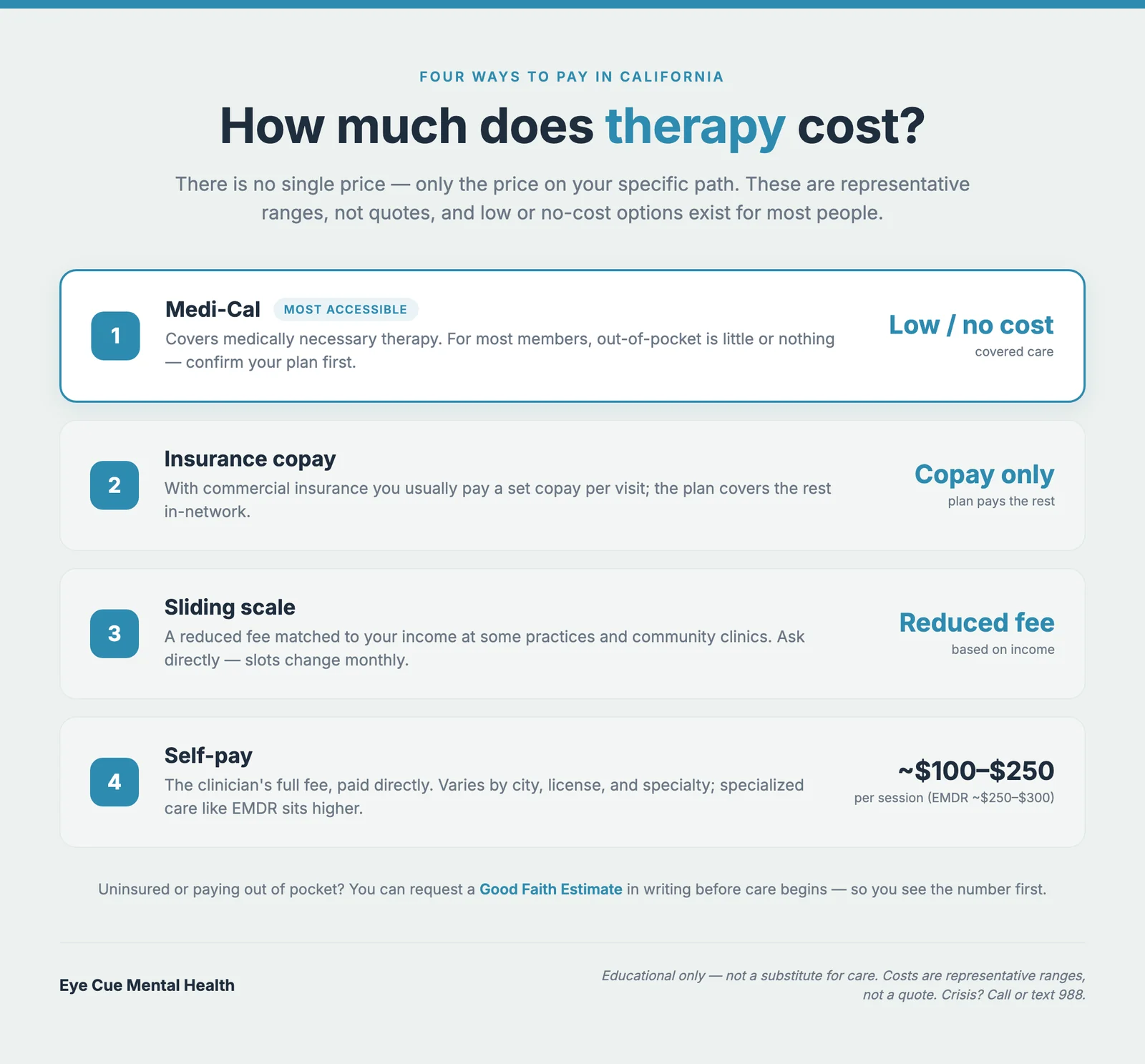
Here is the honest shape of it in California, as representative ranges rather than quotes. Self-pay with a private clinician often lands somewhere around $100 to $250 a session. With commercial insurance, you usually pay just a copay. With Medi-Cal, covered therapy is typically low or no cost.
The rest of this post walks each path plainly, so you can see which one fits and stop guessing.
What does self-pay therapy cost?
Self-pay means you pay the clinician's full fee directly, without insurance. In California a typical self-pay range runs roughly $100 to $250 per session, and specialized care sits higher.
Those are representative figures, not a promise, and they vary by city, license, and specialty. EMDR therapy, for example, is one of the most researched trauma approaches, and self-pay clinicians commonly charge $250 to $300 a session for it.
I say this next part because clients rarely hear it: the sticker fee is not the whole story. Ask any private clinician whether they hold sliding-scale slots or a package rate. Many do, even when it is not advertised.
Why is therapy expensive without insurance?
A self-pay session reflects the clinician's license and the unpaid hours around your hour. That is the real cost, but it is not the only path to care.
Behind one 50-minute session sit notes, coordination, and the years of training and supervision that let someone practice safely. When you pay out of pocket, you cover all of it at once. Ask about the alternatives before you decide the price is the answer.
If cost is the wall between you and starting, the paths below exist specifically to lower it. Most people qualify for at least one and do not realize it.
What are the low-cost and no-cost ways to pay for therapy?
The lowest-cost paths are Medi-Cal, insurance copays, and sliding-scale fees, and one of them fits most people. Each lowers what leaves your pocket in a different way.
Medi-Cal (low or no cost)
Medi-Cal covers medically necessary mental health care, including individual therapy, and for most members the out-of-pocket cost is little or nothing. This is the path I built the practice around, and Medi-Cal is our most common insurance.
If you have Medi-Cal, that card is often the difference between "someday" and "this month." Confirm your specific plan first, since networks differ, and then start. We check it for you before your first session.
Insurance copay
If you have commercial insurance, you usually pay a set copay per visit rather than the full fee. The plan pays the rest of an in-network session.
Call the number on your card and ask three things: is outpatient mental health covered, what is my copay, and do I have a deductible to meet first. Those answers turn a scary unknown into a real, small number.
Sliding scale
A sliding-scale fee is a reduced rate matched to your income, offered by some private practices and community clinics. Instead of the full self-pay rate, you pay what you can reasonably afford.
Availability changes month to month, so ask directly whether sliding-scale openings exist. A "not right now" is worth asking again in a few weeks.
Does telehealth cost less than in-person therapy?
Telehealth usually costs the same per session as in-person care, but it lowers the hidden costs around it. The session fee is set by the clinician and your coverage, not by the room.
What video visits actually save is gas, parking, childcare, and time off work, which for many people is a real barrier of its own. Telehealth therapy across California also widens your options if no in-network clinician is close to home.
Choose telehealth when travel or scheduling is the obstacle. Choose in person when a physical space helps you settle. At our practice you can switch between them without changing therapists.
How do I find out my exact cost before I start?
You ask for it in writing, and you are legally entitled to. You should never have to walk into therapy guessing what it will cost.
Under the federal No Surprises Act, per the Centers for Medicare and Medicaid Services, if you are uninsured or paying out of pocket you can request a Good Faith Estimate of expected charges before care begins. It puts the number in front of you first.
Before you commit to anything, get your path priced. Call your insurer for your copay, confirm your Medi-Cal plan, or ask any practice for a written estimate. We do this with every client at Eye Cue Mental Health, and you can compare it against our full therapy services.
The questions I hear most about what therapy costs, answered plainly.
Ready to start? Let's find your lowest-cost path to therapy
Cost should be the reason therapy becomes possible, not the reason it stays out of reach. Wondering how much therapy will cost you? Call Eye Cue Mental Health at 562-860-2891 and we will walk your specific coverage with you. For many of our clients, care covered by Medi-Cal means little or nothing out of pocket, in Cerritos or by video statewide.
This article was written by Saqib Iqbal, LCSW, founder of Eye Cue Mental Health in Cerritos, California. He opened the practice in 2017 to bring private-practice-quality psychotherapy to Medi-Cal clients and supervises the clinical team.
Frequently asked questions
How much does therapy cost per session?
It depends entirely on how you pay. Self-pay rates with a private clinician in California commonly run in a representative range of roughly $100 to $250 a session, with specialized care like EMDR often $250 to $300. With insurance, you usually pay only a copay. With Medi-Cal, covered therapy is typically low or no cost. There is no single price, which is why asking about your specific path matters more than a headline number.
Is therapy covered by Medi-Cal?
Yes. Medi-Cal covers medically necessary mental health services, including individual therapy, and for most members the out-of-pocket cost is little or nothing. At Eye Cue Mental Health, Medi-Cal is our most common insurance. We confirm your specific plan before your first session so there are no surprises.
What is a sliding scale in therapy?
A sliding scale is a reduced fee based on your income, offered by some private practices and community clinics. Instead of the full self-pay rate, you pay an amount matched to what you can afford. Availability and the exact discount vary by provider, so ask directly whether sliding-scale slots are open.
Why is therapy so expensive without insurance?
A self-pay session reflects a licensed clinician's training, the hour of care, and the unpaid time around it: notes, scheduling, and continuing education. That is real, but it is not the only path. Insurance, Medi-Cal, sliding scale, and telehealth all exist specifically to lower what you pay, and many people qualify for one of them without realizing it.
Do I have to know my exact cost before I start therapy?
No, and you should not have to guess. Under the federal No Surprises Act, if you are uninsured or paying out of pocket you can request a Good Faith Estimate of expected costs in writing before you begin. Call us at 562-860-2891 and we will help you understand your specific cost before your first appointment.
Therapy covered by Medi-Cal in Cerritos and by telehealth across California, often at little or no cost to you.
Learn moreEye Cue Mental Health is a psychotherapy practice and does not prescribe medication. This article is educational and is not a diagnosis or a substitute for professional care. Costs described are representative ranges, not a quote; your actual cost depends on your plan and provider. If you are in crisis, call or text 988 (Suicide and Crisis Lifeline) any time.
