


You have decided therapy might help, and now the practical question lands: does insurance cover therapy, and what will this actually cost me? It is one of the most common worries I hear, and it is a fair one. I'm Saqib Iqbal, LCSW, and I opened Eye Cue Mental Health in Cerritos to bring private-practice-quality care to people who assumed it was out of reach. Before you book anything, checking your Medi-Cal or insurance coverage removes most of the guesswork, and here is exactly how to do it.

Does insurance cover therapy?
Most health insurance plans do cover therapy, though what you pay depends on your specific plan. Under the federal Mental Health Parity and Addiction Equity Act, plans that offer mental health coverage generally must do so on terms comparable to medical care. The Affordable Care Act also made mental health an essential benefit on Marketplace and most individual plans.
So the question is usually not whether therapy is covered at all. It is how your particular plan covers it, which therapists count as in-network, and what your share of the cost looks like.
Coverage also varies by the type of plan you carry. Medi-Cal covers medically necessary outpatient mental health for eligible Californians at little or no cost. Employer and Marketplace plans usually cover it too, but with a copay or a deductible you meet first.
That is good news, because it means the answer is knowable before you commit. A short call to your insurer turns a vague worry into a real number you can plan around, and it is the first thing I encourage anyone to do.
What insurance terms actually mean for therapy
A handful of terms decide what you pay, and insurers rarely explain them in plain language. Here is what each one means for a therapy session, without the jargon.
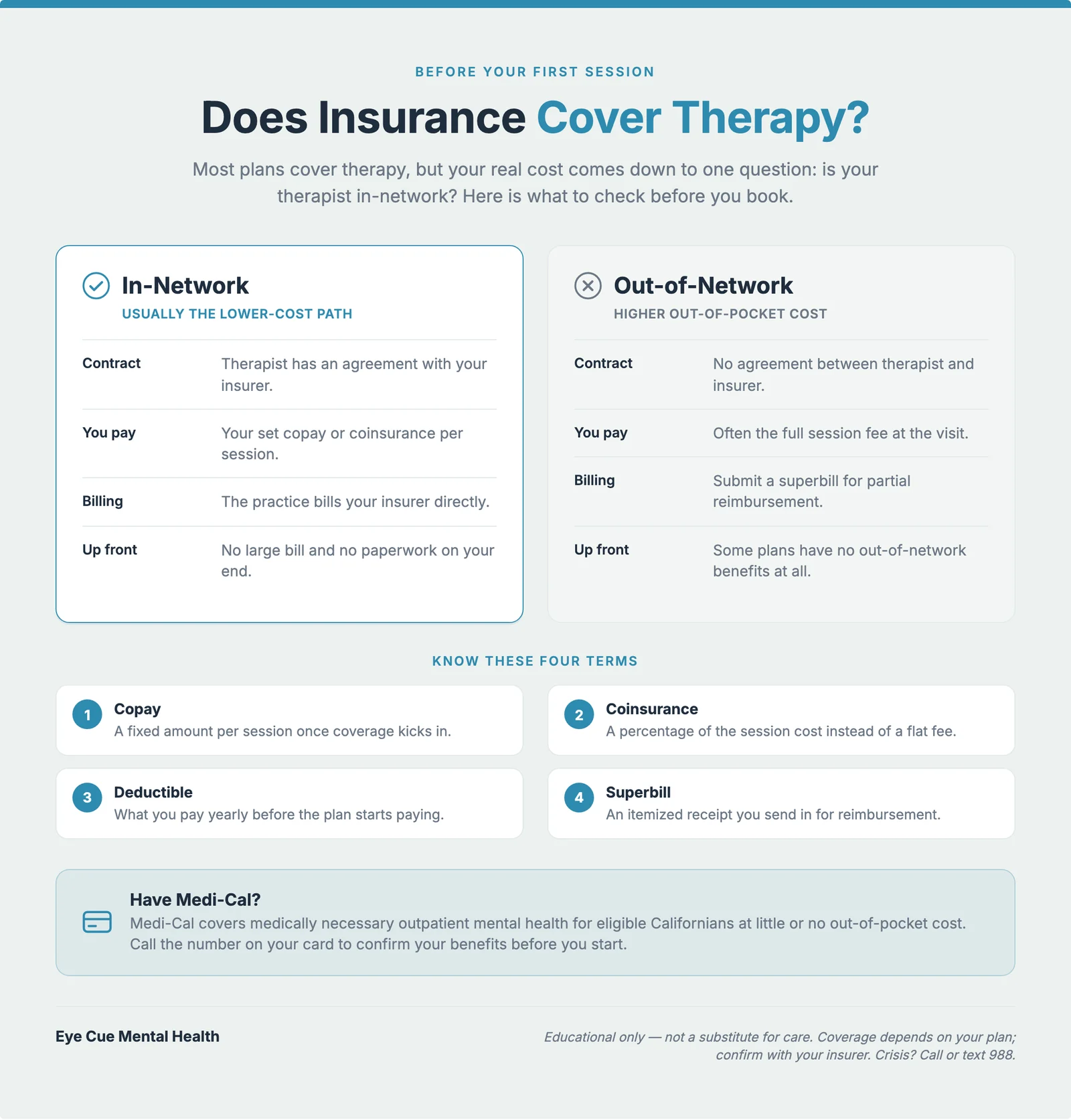
- Copay: a fixed amount you pay per session, like $30, once your coverage kicks in. You will see it on your insurance card next to "specialist" or "mental health."
- Coinsurance: a percentage of the session cost you pay instead of a flat fee, common on some plans after the deductible is met.
- Deductible: the amount you pay out of pocket each year before the plan starts paying. If your deductible is not met, you may owe more per session early in the year.
- In-network: the therapist has a contract with your insurer, so you pay the set copay and the practice bills your insurer directly.
- Out-of-network: no contract; you often pay up front and may get partial reimbursement if your plan allows it.
Once you know these five, most of the confusion clears. Your real cost per session is usually just your copay or coinsurance after the deductible.
In-network vs out-of-network: which costs less?
In-network care almost always costs less, because your insurer has already negotiated the rate. You pay your set copay or coinsurance, and the practice handles the billing. There is no large bill up front and no paperwork on your end.
Out-of-network works differently. You typically pay the full session fee when you come in, then submit for reimbursement if your plan has out-of-network benefits. Some plans have none, which means you carry the full cost.
There is one exception worth knowing. Some people choose an out-of-network therapist on purpose, usually to see a specific specialist or to keep a diagnosis off their insurer's record. That is a valid choice, but go in knowing the higher out-of-pocket cost.
When you call your insurer, this is the single most useful thing to confirm: is the therapist or practice in-network for my plan? If they are, you have found the lower-cost path. At Eye Cue Mental Health, Medi-Cal is our most common plan, and we accept several private plans as well, so for many people in-network care is available.
What is a superbill, and when do you need one?
A superbill is an itemized receipt from your therapist that you send to your insurer to request out-of-network reimbursement. You only need one when you are seeing an out-of-network provider and your plan offers out-of-network benefits.
The superbill lists the session date, the service code, a diagnosis code, the fee you paid, and the practice's tax ID. Your insurer uses that to decide how much of your out-of-network deductible and coinsurance to apply.
Submit it through your insurer's member portal or the address on your card, and keep a copy. A superbill is a reimbursement request, not a promise; how much comes back depends on your plan's out-of-network terms.
One more tip: ask your insurer how they want it submitted and how long reimbursement usually takes. Some pay within a few weeks; others need a claim form attached. Knowing the process up front saves you from chasing paperwork later.
How to verify your therapy benefits in one phone call
You verify your benefits by calling the member services number on the back of your insurance card and asking a short list of questions. It takes about ten minutes, and it is worth doing before your first session so there are no surprises.
Have your card in hand and ask the representative these questions:
- Do I have outpatient mental health coverage, and does it include individual therapy or telehealth?
- Is [the specific therapist or practice] in-network for my plan?
- What is my copay or coinsurance for an outpatient mental health visit?
- Do I have a deductible, and how much of it is left this year?
- If the provider is out-of-network, do I have out-of-network benefits, and what is that reimbursement rate?
Write down the representative's name and a reference number for the call. If anything later does not match, that record helps you sort it out quickly.
What if you are uninsured or your plan does not cover therapy?
You still have real options, and cost does not have to be the reason you wait. Under the federal No Surprises Act, if you are uninsured or paying out of pocket, you have the right to a good faith estimate of your costs before care begins.
Many Californians also qualify for Medi-Cal, which covers medically necessary outpatient mental health at little or no out-of-pocket cost. It is our most common coverage, and it is why the practice exists in the first place.
If you are not sure where you stand, that is exactly what we are here for. We accept Medi-Cal for therapy, offer telehealth across California as well as in-person sessions in Cerritos, and can walk you through your options before you commit to anything. Cost should be the smallest part of this decision, not the wall you stop at.
The questions I hear most about therapy and insurance coverage, answered in plain language.
Ready to check your coverage? Start therapy the affordable way
You do not have to guess at what therapy will cost, and you do not have to put it off because the billing feels confusing. If you want a straight answer about your coverage, mental health treatment at Eye Cue Mental Health starts with a real conversation about your plan and your options. We see clients in person in Cerritos and by video across California, and we accept Medi-Cal and many private plans. Call 562-860-2891 and we will help you verify your benefits.
This article was reviewed by Saqib Iqbal, LCSW, founder of Eye Cue Mental Health in Cerritos, California. He opened the practice in 2017 specifically to make therapy accessible to Medi-Cal clients, and he reviews the practice's guides on coverage and access for accuracy.
Frequently asked questions
Does health insurance cover therapy?
In most cases, yes. Under the federal Mental Health Parity and Addiction Equity Act, most plans that cover mental health must cover it comparably to medical care, and the Affordable Care Act made mental health an essential health benefit on Marketplace and most individual plans. That said, the specifics, like which therapists are in-network and what you pay per session, depend on your plan. Verifying your benefits before you start is the only way to know your real cost.
How much does therapy cost with insurance?
It depends on your plan. If you have not met your deductible, you may pay the plan's negotiated rate for a session until you do. After that, you typically owe a fixed copay or a percentage coinsurance for in-network care. Medi-Cal covers medically necessary outpatient mental health with little or no out-of-pocket cost. Call the number on your insurance card and ask for the outpatient mental health copay and deductible to get your real figure.
What is the difference between in-network and out-of-network therapy?
In-network means the therapist has a contract with your insurer, so you pay the plan's set copay or coinsurance and the practice bills your insurer directly. Out-of-network means no contract; you often pay the full fee up front and, if your plan has out-of-network benefits, submit a superbill for partial reimbursement. In-network care is usually the lower-cost path when it is available.
What is a superbill and how do I use it?
A superbill is an itemized receipt your therapist gives you after a session, listing the date, service (CPT) code, diagnosis code, fee, and the practice's tax ID. If your plan has out-of-network benefits, you submit the superbill to your insurer to request partial reimbursement. It is not a guarantee of payment; how much comes back depends on your out-of-network deductible and coinsurance.
What if I do not have insurance or my plan does not cover therapy?
You still have options. Under the No Surprises Act, if you are uninsured or paying out of pocket you have the right to a good faith estimate of your costs before care begins. Many people also qualify for Medi-Cal, which covers outpatient mental health at little or no cost. Eye Cue Mental Health accepts Medi-Cal; call us at 562-860-2891 and we will help you check your options.
We accept Medi-Cal and several private plans, in Cerritos and by telehealth across California. Verify your therapy coverage before you start.
Learn moreEye Cue Mental Health is a psychotherapy practice. This article is educational and is not financial, legal, or medical advice, and it is not a diagnosis or a substitute for professional care. Coverage depends on your specific plan; confirm your benefits with your insurer. If you are in crisis, call or text 988 (Suicide and Crisis Lifeline) any time.
