


Bipolar disorder in women often looks like recurring depression with hidden or overlooked high periods, which is part of why it can go unrecognized for years. It's a real, treatable mood condition, not a personality flaw or a phase. If your moods have been swinging in ways that scare or confuse you, talk therapy at Eye Cue Mental Health can help you make sense of it, in person in Cerritos or by video across California. This article is educational, not a diagnosis; only a clinician can diagnose bipolar disorder.
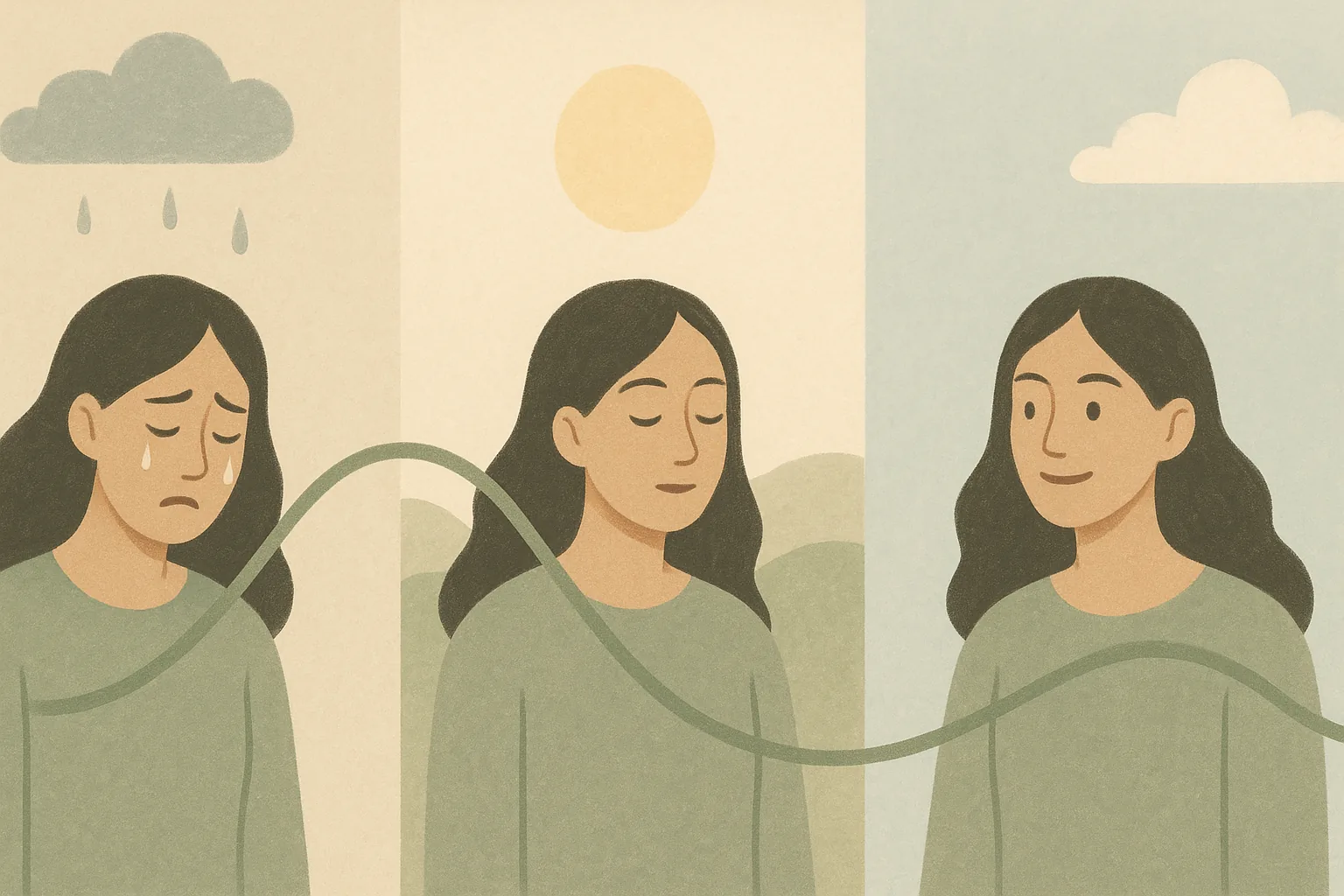
I'm Saqib Iqbal, LCSW, and I founded Eye Cue Mental Health in Cerritos to bring good therapy to people who often go without it. Over the years, the pattern I see most with women and mood is this: someone comes in exhausted by a depression that keeps coming back, and no one has ever asked about the flip side. So let's talk about what bipolar disorder can look like in women, why it gets missed, and when it's worth an evaluation.
What is bipolar disorder, in plain terms?
Bipolar disorder is a mood condition marked by distinct episodes of unusually high mood or energy and episodes of depression. Per the National Institute of Mental Health, these mood episodes are more intense and longer-lasting than ordinary ups and downs, and they affect sleep, thinking, energy, and behavior.
The "high" side is called mania or, in a milder form, hypomania. Mania can involve racing thoughts, little need for sleep, fast speech, and risky decisions. Hypomania is subtler and can even feel productive, which is exactly why it slips past unnoticed.
The "low" side is a depressive episode: deep sadness or emptiness, loss of interest, fatigue, and trouble concentrating. Bipolar disorder isn't ordinary moodiness. It's a real medical condition, and it responds to care.
What are the main bipolar disorder symptoms in women?
The main symptoms in women are the same two poles, but the balance often tilts toward depression, with more frequent lows and more mixed states. Per the National Institute of Mental Health, the core features are episodes of mania or hypomania and episodes of depression; what tends to differ is how often each shows up.
Use the two lists below as a map, not a self-diagnosis. Noticing yourself in them is a reason to talk to a clinician, not a verdict.
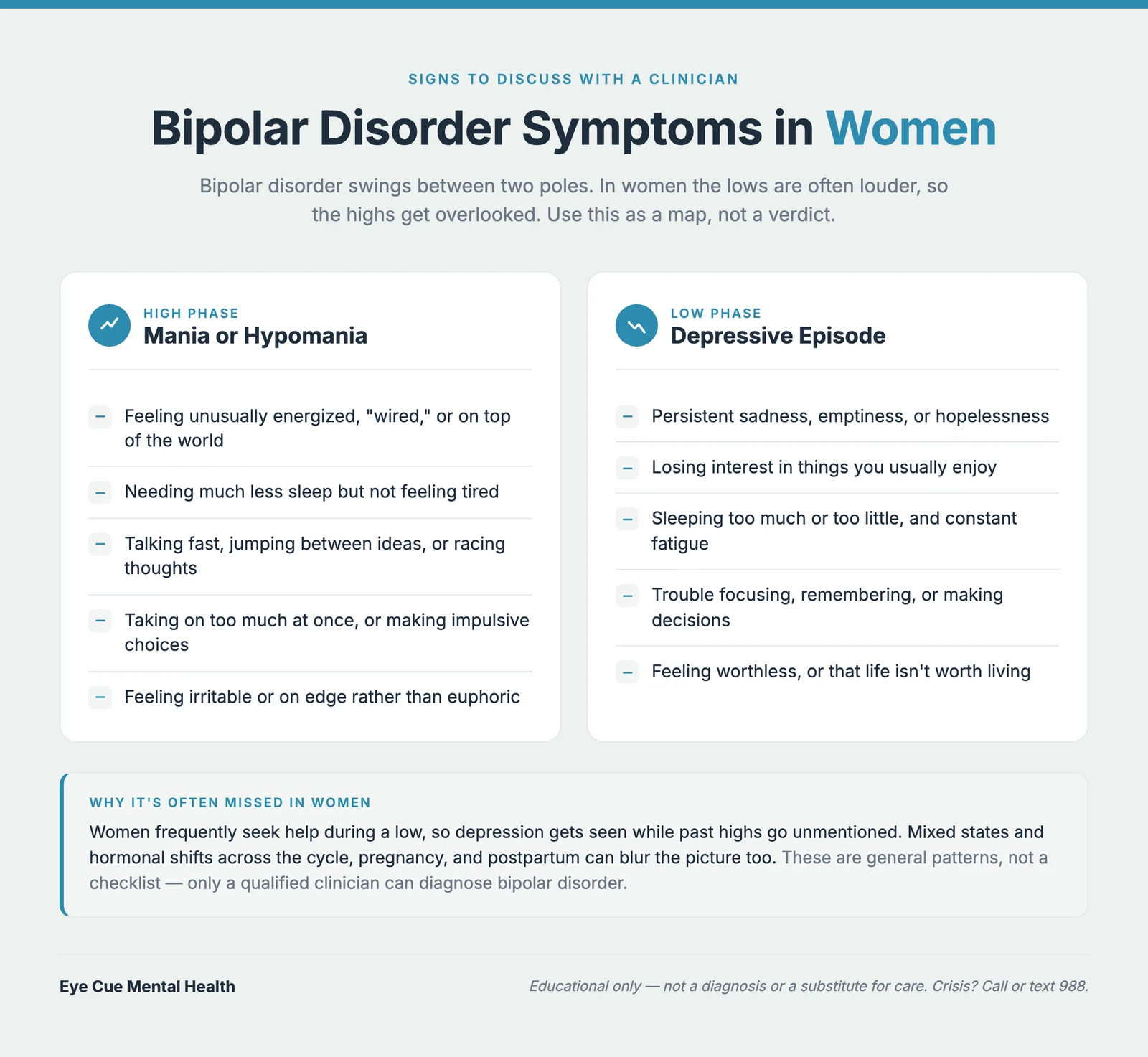
Signs of a high (manic or hypomanic) phase can include:
- Feeling unusually energized, "wired," or on top of the world
- Needing much less sleep but not feeling tired
- Talking fast, jumping between ideas, or racing thoughts
- Taking on too much at once, or making impulsive choices
- Feeling irritable or on edge rather than euphoric
Signs of a low (depressive) phase can include:
- Persistent sadness, emptiness, or hopelessness
- Losing interest in things you usually enjoy
- Sleeping too much or too little, and constant fatigue
- Trouble focusing, remembering, or making decisions
- Feeling worthless, or having thoughts that life isn't worth living
That last point matters. If thoughts of death or self-harm are present, you don't have to wait for a diagnosis to get help. Call or text 988, the Suicide and Crisis Lifeline, any time.
How can bipolar disorder look different in women?
Bipolar disorder can present differently in women, who more often have depression-heavy patterns, rapid cycling, and mixed episodes. In practice, that often means women are more likely to be diagnosed with bipolar II, to cycle more rapidly, and to have mixed states, even though bipolar disorder occurs at similar rates in men and women.
A few patterns come up again and again in the women I sit with.
The depression is louder than the highs
Many women live with the lows front and center while the highs are mild hypomania that feels like a good, capable stretch. When the high never registers as a problem, the story that gets told is "my depression keeps coming back," and the fuller picture stays hidden.
Mixed episodes blur the line
A mixed episode means high and low symptoms happen at the same time: agitated and hopeless, restless and exhausted. It's confusing and painful, and it doesn't fit the neat "up then down" idea most people carry about bipolar disorder.
Hormonal shifts can move the moods
For some women, mood episodes track with the menstrual cycle, pregnancy, or the postpartum weeks. If you notice your moods shift hard around these times, it's worth mentioning to a clinician. Our therapy for perinatal and postpartum mental health supports women through exactly these transitions.
Why is bipolar disorder often missed or misdiagnosed in women?
Bipolar disorder is frequently misdiagnosed as depression in women because they usually seek help during a low, when the highs aren't on anyone's radar. In the women I work with, bipolar disorder is often first diagnosed as major depression, which can delay the right care.
Here's the trap. If a clinician only asks about how you feel now, and now is a depression, then depression is what they'll find. The high periods, especially gentle hypomania, feel like relief, not illness, so no one thinks to bring them up.
This is why a thorough history matters so much. A good evaluation asks specifically about past stretches of little sleep, racing thoughts, unusual confidence, or spending, not just the current low. If you've ever had a period like that, say so, even if it felt good at the time. It's one of the most useful things you can tell a clinician.
How is bipolar disorder diagnosed?
Bipolar disorder is diagnosed by a qualified clinician through a detailed interview about your mood history, not by a single test or a checklist. Per the American Psychiatric Association, diagnosis rests on the pattern of manic, hypomanic, and depressive episodes over time, ruling out other medical and mental health causes.
There is no blood test or brain scan that confirms it. What helps is your lived timeline: when moods shifted, how long episodes lasted, how they affected sleep and daily life. Bringing a partner or family member who has seen your patterns can add detail you might not notice in yourself.
I want to be clear about scope here. Nothing you read online, this article included, can diagnose you. What an article can do is help you decide it's worth asking, and describe what a real evaluation looks like so it feels less intimidating.
How is bipolar disorder treated?
Bipolar disorder is treated with a combination of medication and psychotherapy, coordinated over time. Per the National Institute of Mental Health, long-term treatment usually includes medication managed by a prescriber alongside talk therapy that builds skills and support.
Therapy does real work in bipolar care. It helps you spot early warning signs of an episode, steady your sleep and daily rhythm, process the toll the condition takes, and stay connected to a plan. Many people find that structured, ongoing support makes episodes shorter and less disruptive.
At Eye Cue Mental Health, that support usually looks like a steady course of individual therapy, often paired with our depression therapy approach when the lows are the heaviest part. As a psychotherapy practice, we don't prescribe medication, so we coordinate with an outside prescriber when medication is part of your plan. Because we accept Medi-Cal and several private plans and offer telehealth across California as well as in-person sessions in Cerritos, it's easier to get consistent care instead of starting over each time a low returns.
The questions women ask me most about bipolar disorder symptoms, answered in plain language. None of this replaces an evaluation.
Ready to make sense of your moods? Start therapy in Cerritos or by telehealth
You don't have to keep guessing whether what you're feeling is "normal." If your moods have been swinging, or a depression keeps circling back, talk therapy at Eye Cue Mental Health gives you a private, judgment-free space to understand the pattern and get the right kind of help. We see clients in person in Cerritos and by video across California, and we accept Medi-Cal and many private plans. Call 562-860-2891 to talk it through. If you're ever in crisis, call or text 988 any time.
This article was reviewed by Saqib Iqbal, LCSW, founder of Eye Cue Mental Health in Cerritos, California. He supervises the clinical team and reviews the practice's mental health guides for accuracy. He does not diagnose or treat readers through this article; a diagnosis requires an evaluation with a licensed clinician.
Frequently asked questions
What are the main symptoms of bipolar disorder in women?
Bipolar disorder involves distinct episodes of elevated or irritable mood (mania or hypomania) and episodes of depression. In women, the depressive episodes are often more frequent and longer, and mixed states, where high and low symptoms happen together, are common. These are general patterns, not a checklist. Only a clinician can diagnose bipolar disorder after a full evaluation.
How is bipolar disorder different in women than in men?
Research suggests women more often experience bipolar II, more depressive episodes, rapid cycling, and mixed episodes, and that symptoms can shift with hormonal changes across the menstrual cycle, pregnancy, and postpartum. Rates of the disorder are similar across sexes, but the presentation and course can differ, which is one reason it is sometimes missed in women.
Why is bipolar disorder often misdiagnosed in women?
Because women frequently come in during a low period, the depression is what gets seen and treated, while past highs go unmentioned or unnoticed. That can lead to a diagnosis of depression alone. A careful history that asks specifically about periods of unusually high energy, reduced need for sleep, or racing thoughts helps distinguish the two.
Can bipolar disorder symptoms change during pregnancy or postpartum?
For many women, yes. The weeks after childbirth are a period of higher risk for mood episodes, and postpartum mood changes deserve prompt attention. If you have a history of bipolar disorder or notice significant mood shifts around pregnancy, tell your care team early so support can be put in place.
When should I see a therapist about possible bipolar symptoms?
Reach out if you notice cycles of very high and very low mood, if depression keeps returning, or if mood changes are affecting your sleep, work, or relationships. You do not need a diagnosis first. Call us at 562-860-2891 to talk it through, and if you ever feel unsafe, call or text 988.
Talk therapy for mood changes in Cerritos and by telehealth across California, covered by Medi-Cal.
Learn moreEye Cue Mental Health is a psychotherapy practice and does not prescribe medication. This article is educational and is not a diagnosis or a substitute for professional care. Bipolar disorder can only be diagnosed by a qualified clinician. If you are in crisis or thinking about harming yourself, call or text 988 (Suicide and Crisis Lifeline) any time.
